Barramundi Life Cycle: Sex Change, Spawning and Migration Explained
Why the Barramundi Life Cycle Matters to Anglers
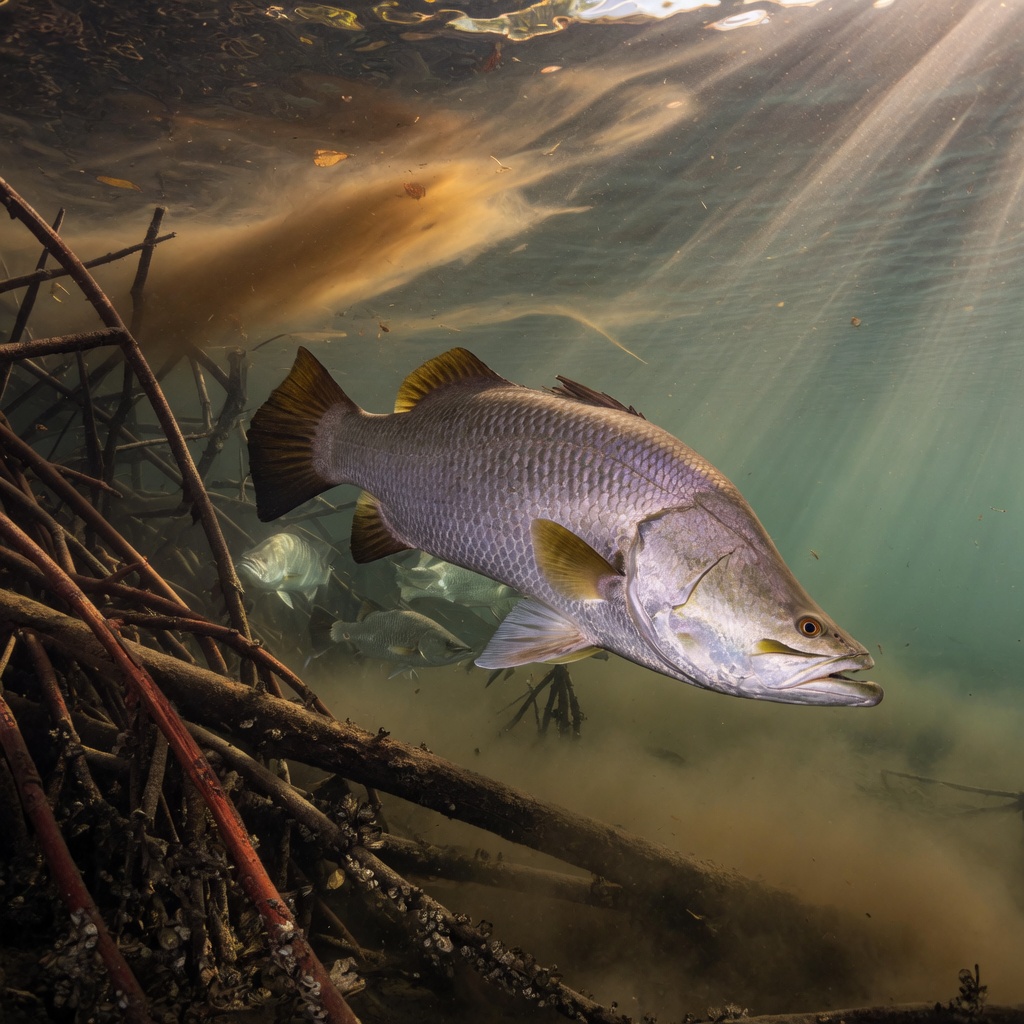
Barramundi (Lates calcarifer) are one of the few Australian sportfish whose biology directly explains where you should be casting in any given month. They are catadromous, meaning they spend part of their lives in fresh water but must return to salt water to breed, and they are protandrous hermaphrodites, which means most fish begin adult life as males and later become females. Understanding those two facts turns a random session into a plan: it tells you why the big fish in a system are almost always females, why creek mouths fire in the build-up, and why a barra caught 200 km upstream in a Territory billabong may never have seen the sea as an adult.
From Egg to Juvenile: The Saltwater Nursery
Spawning happens in the lower reaches of tidal estuaries, around river mouths, headlands and coastal foreshores where salinity is high. Eggs are released in enormous numbers, fertilised externally and left to drift with the tide. Within roughly a day they hatch into tiny larvae that rely on tidal currents to carry them into supratidal swamps, saltmarsh, mangrove drains and coastal wetlands. These warm, shallow, food-rich nurseries are the single most important habitat in the whole cycle. Juveniles feed hard on prawns, small baitfish and insects, then progressively move down drains and into main-channel creeks as they grow. Loss or blocking of these wetlands, through bunding, road crossings and drainage works, removes recruitment years before anglers ever notice a decline, which is why habitat protection sits alongside bag limits in barramundi management.
Sex Change: Small Males, Big Females
Most barramundi mature first as males at roughly 550 to 650 mm, spawn as males for several seasons, then transition to female at around 850 mm to a metre depending on the population. There are exceptions, including fish that appear to develop as females directly, but the general rule holds: the metre-plus fish photographed on the deck of a boat is almost certainly a female carrying the reproductive future of that system. This is the biological logic behind slot limits in several jurisdictions, which protect both undersize males and the oversize breeding females. It is also why careful handling matters. Support big fish horizontally, keep them wet, minimise air exposure, use single hooks or crushed barbs where practical, and avoid lifting heavy females vertically by the jaw.
Migration: Salt, Brackish and Fresh
Adult barramundi move between three broad zones. Wet-season flows open access to floodplain lagoons, billabongs and freshwater reaches, where fish grow quickly on abundant prey and low competition. As the floodplain dries through the late dry, fish are funnelled back down creeks and channels, concentrating at drains, snag lines and channel junctions. Mature fish then move toward the estuary mouth ahead of spawning. Some populations are effectively landlocked in impoundments; they still grow large and still change sex, but recruitment depends on stocking rather than natural spawning because larvae cannot reach saltwater nurseries.
Seasonal Timing in the Australian North
Spawning is broadly tied to the warm months from roughly September through to March, peaking in the pre-monsoon build-up and early wet, and it is strongly linked to water temperature above about 28 degrees, big spring tides and the new and full moons. Practical implications:
- Build-up (Sep to Nov): target estuary mouths, rock bars and headlands on large tides; fish are staging and aggressive.
- Wet (Dec to Mar): run-off creates dirty water and current lines; fish drain mouths and colour changes on the falling tide.
- Run-off and early dry (Apr to Jun): the classic period as fish drop out of the floodplain and stack at creek entrances.
- Late dry (Jul to Aug): cooler water slows feeding; work deeper snags, sunny afternoons and structure holding warmth.
Closed seasons apply in several states to protect spawning aggregations, and dates, size slots and bag limits differ between Queensland, the Northern Territory and Western Australia and change over time. Always confirm the current rules with the relevant state or territory fisheries authority before you fish.
Reading the Life Cycle on the Water
Match your approach to the life stage in front of you. Around nursery drains and shallow flats, expect large numbers of small males; downsize lures to 65 to 95 mm hard bodies or soft plastics and fish light leaders of 20 to 30 kg only where snags demand it. At spawning-time staging areas near the mouth, expect fewer but far heavier fish; step up to 120 mm+ minnows, big paddle-tails, heavier trebles or single hooks, and leaders capable of handling rock bars. In fresh reaches and impoundments, focus on structure such as timber, weed edges and points, and time sessions to moon phase and stable barometric pressure. If you release a big female, revive her beside the boat facing into current until she kicks away strongly.
Related Reading and Contact
For side-by-side identification notes, comparable species behaviour and more on how growth and sex determine size limits, see our species profiles and identification guides. Australian Fish Species is written from Sydney for anglers across Australia, with metric measurements and Southern Hemisphere seasons throughout. Questions, corrections or regional observations are welcome at [email protected] or +61295585271 during Mon–Fri: 09:00 – 17:00 (AEST).

Navigation
See also
FAQ