Berley Trails That Bring Fish Within Casting Range
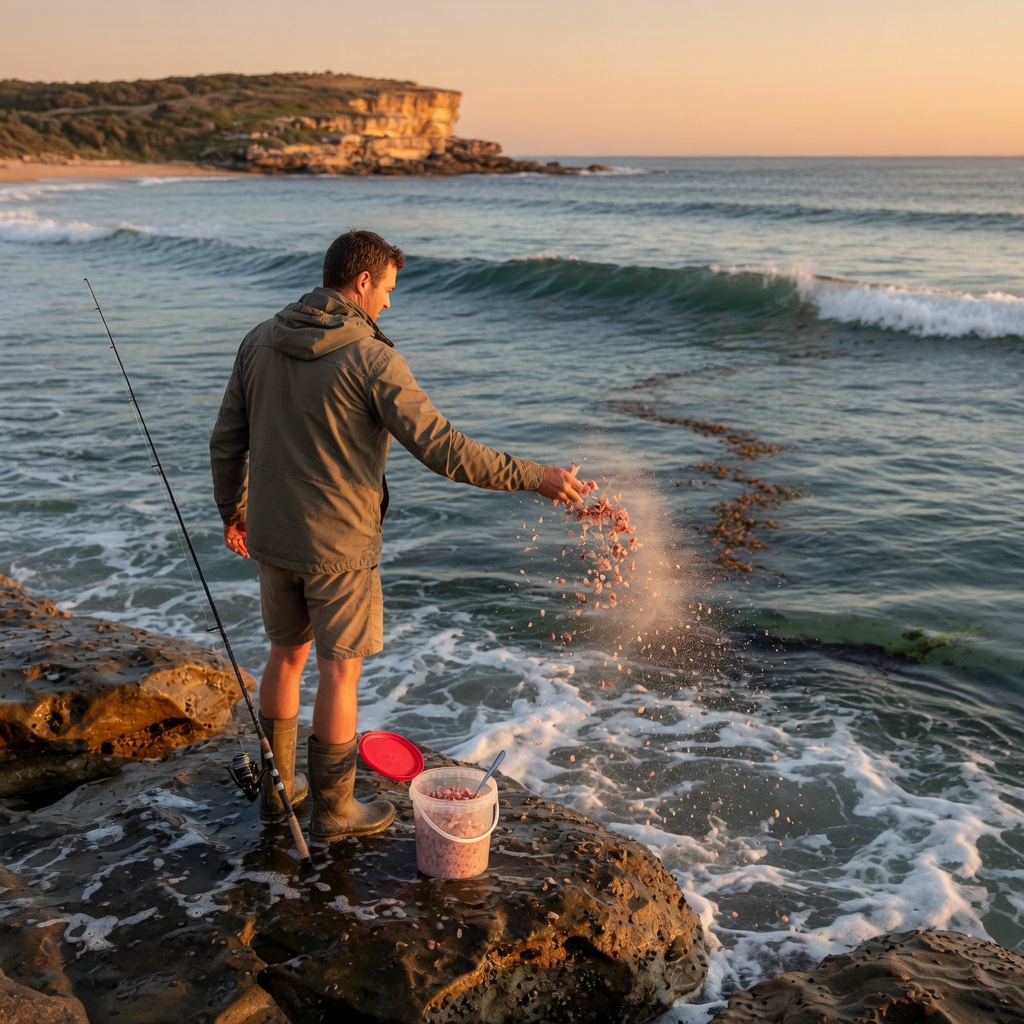
What a Berley Trail Actually Does
Berley (also called burley or chum) is scent, sound and small food particles released into moving water to draw fish up-current towards your baits. A trail does not create fish out of nothing. It shortens the distance between the fish that are already holding in a system and the water you can reach with a cast. On a Sydney estuary flat, that might mean pulling bream out of the mangrove edge onto a sand hole 15 m away. Off the ocean rocks, it might mean lifting a school of Australian salmon or tailor from deep water into the wash where a pilchard on a set of ganged hooks can be presented naturally.
The principle is simple: fish follow a scent gradient towards its strongest point. Your job is to make that point the exact patch of water where your hook sits, and to keep the trail unbroken long enough for fish to work up it. A single bucket dumped in one go does the opposite; it feeds the school downstream of you and then goes quiet.
Matching the Mix to the Species
Different fish respond to different particle sizes and oil content. Understanding feeding habits from the species profiles and identification guides makes mix selection much easier.
- Bream, whiting and small estuary species: fine mixes with chicken pellets, breadcrumb, tuna oil and mashed prawn heads. Small particles keep fish searching rather than filling up.
- Mulloway and larger predators: chunky fish frames, gut and heavier oil, released slowly on the run-out tide near bridge pylons, deep holes and drop-offs.
- Snapper and reef species: crushed pilchard, chopped squid and a weighted berley bomb to get the scent down to structure instead of losing it in surface drift.
- Kingfish and pelagics: live or cubed baits drifted at the same speed as your hook bait, so the offering sinks and behaves identically to the free food.
- Rock and beach fishing for tailor and salmon: pilchard offcuts and bread crumbed into the white water, timed with wave sets so it washes into the strike zone rather than straight back out.
Timing the Trail With Tide, Light and Weather
Berley works best when water is moving. In Sydney estuaries, the first two hours of a run-out tide often concentrate bait against channel edges, and a trail placed up-current of a drop-off will hold fish for a long stretch of that tide. Slack water is the weakest window: scent pools around the boat and fish lose the thread.
Low light adds to the effect. Dawn, dusk and the hours either side of a moon change tend to line up with stronger feeding periods, so a trail started 20 minutes before the window opens has fish already committed when the bite begins. In dirty water after rain, increase oil content and reduce particle size, because fish are hunting by smell far more than sight.
Building a Trail That Holds Fish
- Anchor or position so that current carries scent away from you, not under the hull.
- Start with three or four small handfuls a minute apart to establish the gradient.
- Settle into a steady rhythm: a small amount every 60 to 90 seconds is far better than a large amount every ten minutes.
- Cast baits into the trail, not past it, and let them drift naturally with minimal weight.
- When fish arrive, reduce the volume. Keep them looking rather than feeding them full.
- If the bite fades, change the mix or particle size before you change locations.
Common Mistakes
- Too much, too fast. Overfeeding shuts a session down within half an hour.
- Trail and bait in different water. If your sinker drags the bait out of the scent lane, the trail simply feeds fish that never see the hook.
- Wrong sinker weight. Match sink rate to your berley particles so hook baits fall alongside the free food.
- Ignoring bycatch. Heavy oily trails in shallow estuary water can attract unwanted attention; move on rather than persisting.
Safety and Responsible Use
Berleying from ocean rock platforms means standing near the water for extended periods with your attention on a bucket rather than the swell. Check the marine forecast and swell period before you commit, wear a lifejacket and cleated boots, fish with a partner and identify an escape route before you set up. Never lean over a ledge to spread berley.
Use fresh or properly frozen materials, avoid dumping unused berley at the ramp, and rinse buckets away from the waterline. Do not introduce non-local fish scraps into freshwater systems such as the Murray-Darling, where disease and translocation risks are real concerns. Fisheries rules on bait, berley and closed areas vary between NSW, QLD, VIC, SA, WA, TAS and the NT and change over time, so confirm current requirements with the relevant state or territory fisheries authority before you fish.
Questions about local conditions or mixes for a particular species? Contact Australian Fish Species on +61295585271 or [email protected] during Mon–Fri: 09:00 – 17:00 (AEST).

Navigation
See also
FAQ