Brown, Rainbow and Brook Trout in Australian Waters
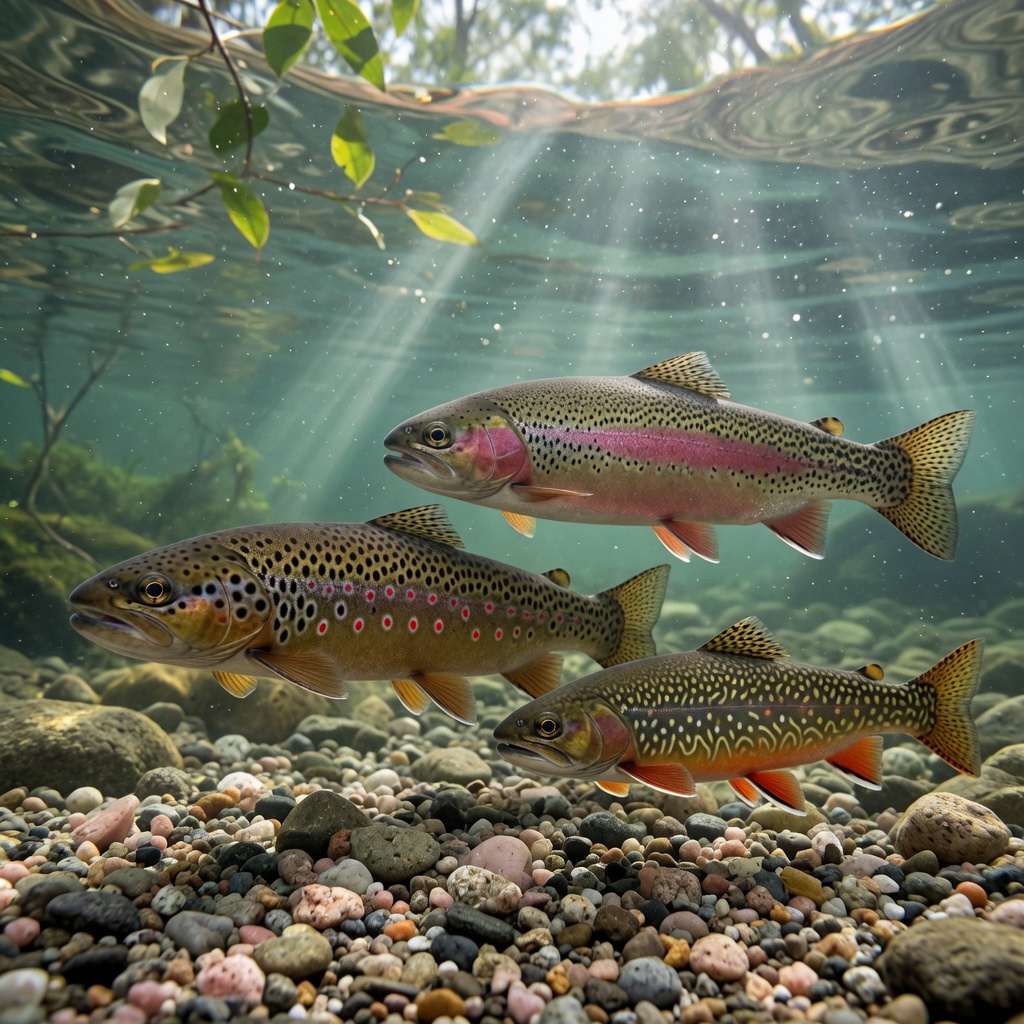
Three Introduced Salmonids, Three Different Fish
Trout are not native to Australia, yet brown trout, rainbow trout and the far less common brook trout now underpin some of the country's most treasured cool-water fisheries. You will find them in the Snowy Mountains and Central Tablelands streams within a few hours of Sydney, throughout Victoria's north-east, in Tasmania's highland lakes, in South Australia's Onkaparinga catchment and in a handful of cold south-west Western Australian streams. Because the three species overlap in many waters, correct identification matters for both your notebook and for understanding which fish you have actually worked out.
This profile sits alongside our wider fish species profiles and identification library, and follows the same approach: look at fin shape, spot pattern and tail markings before you guess from colour alone. Trout colour changes dramatically with water clarity, diet, spawning condition and even the substrate they sit over.
Identifying Brown Trout
Salmo trutta is typically buttery-bronze to olive with scattered black spots and, importantly, rusty-orange or red spots often ringed by pale halos along the flanks. The tail is square to slightly forked and usually unspotted or very lightly marked. Adipose fin is often tinged orange. Browns grow large in lake systems, with fish over 3 kg reasonably common in Tasmanian and Snowy impoundments, while stream residents of 250 g to 1 kg are the everyday reality.
Behaviour is the giveaway as much as the markings. Browns are structure-oriented, territorial and strongly nocturnal in warmer months, holding under undercut banks, log jams and willow roots. They dominate the best feeding lanes in a pool and are the classic target for evening rises and after-dark mudeye or lure work.
Identifying Rainbow Trout
Oncorhynchus mykiss shows a distinct pink to magenta lateral stripe, especially in males and in spawning condition, over a silvery to greenish flank. Spotting is small, black and profuse, and it extends clearly onto the tail and dorsal fin — that heavily spotted tail is the fastest field mark separating rainbows from browns. Body shape is a touch more streamlined and the mouth is generally smaller relative to the head.
Rainbows sit higher in the water column, feed more readily in daylight, and hold in faster oxygenated runs and riffles rather than deep snags. They jump repeatedly when hooked and tolerate slightly warmer, more turbid water than brook trout. Where stocking supports both species, rainbows usually make up the daytime catch and browns the low-light catch.
Identifying Brook Trout
Salvelinus fontinalis is actually a char, not a true trout, and is the rarest of the three in Australia — largely confined to a few stocked lakes and cold headwaters in NSW, Victoria and Tasmania. Look for pale cream to yellow spots on a dark olive-green back, red spots surrounded by blue halos, and vermiculation (worm-like marbling) across the dorsal fin and back. The clincher is the leading edge of the pectoral, pelvic and anal fins: crisp white lines backed by black. Belly colour turns intense orange in autumn males.
Habitat, Temperature and Season
All three species are temperature-limited. Trout feed well between roughly 8 and 16 degrees, become sluggish below 5 degrees and are stressed above about 19 to 20 degrees, with brook trout least tolerant of warm water. That single fact explains almost everything about Australian trout fishing:
- Spring: snowmelt fills streams, tailing fish work flooded lake margins, and hatches build as water warms.
- Summer: fish shift to cold spring inflows, deep lake water and shaded, oxygenated runs. Fish dawn, dusk and after dark.
- Autumn: the prime window. Fish colour up, feed aggressively and move toward spawning gravels.
- Winter: browns and brooks spawn (roughly April to June), rainbows spawn later in winter and early spring. Many rivers close during spawning periods.
Closed seasons, gear restrictions and bag and size limits for trout vary between NSW, Victoria, Tasmania, SA and WA, and they change. Always verify the current rules with the relevant state or territory fisheries authority before you fish, particularly around the traditional close of the trout season and any special-regulation or fly-only waters.
Feeding Behaviour and Diet
Trout in Australian waters eat mayfly and caddis nymphs, midge pupae, terrestrial beetles and ants blown onto the water, grasshoppers through summer, mudeyes (dragonfly nymphs) around lake edges at dusk, small galaxias and smelt, yabbies and freshwater shrimp. Larger browns become heavily fish-oriented and will take a surprisingly big presentation. Read the water: dimpling rises mean small emergers; solid boils and bow waves in shallow margins mean the fish is chasing baitfish or yabbies.
Practical Tackle and Techniques
- Lure casting: 1.8 to 2.1 m ultralight rod, 1000 to 2000 size reel, 2 to 4 kg braid with a 2 to 3 kg fluorocarbon leader. Small bladed spinners, 40 to 60 mm hard-bodied minnows and 50 mm soft plastics on light jigheads.
- Fly fishing: a 5 or 6 weight outfit covers most rivers and lakes. Carry weighted nymphs, a dark wet fly, a small dry for evening rises and a woolly bugger or mudeye pattern for dusk in lakes.
- Bait: where permitted, scrub worms, mudeyes and grasshoppers under a small float or unweighted are hard to beat. Check bait rules for the water you are fishing.
- Presentation: approach from downstream, stay low, cast upstream and let the offering drift naturally. Trout in clear alpine water spook from movement and shadow long before they see the lure.
Handling, Release and Conservation
Trout are fragile in warm water. If the river is above roughly 18 degrees, shorten fights, keep the fish submerged, use barbless or single hooks and a knotless rubber net, wet your hands, and support the fish facing into the current until it swims off under its own power. Avoid extended photo sessions. Where you intend to keep a fish, dispatch it quickly and get it onto ice.
Trout fisheries depend on riparian shade, stable gravels and cold inflows, so stay off spawning beds, avoid trampling stream banks, and never move fish, water or weed between catchments — didymo and other pests spread on wet boots and nets. Clean, drain and dry your gear between systems. For more on species-by-species identification, biology and regional tactics across Australia, browse the rest of the guides at Australian Fish Species, or get in touch on +61295585271 or [email protected] during Mon–Fri: 09:00 – 17:00 (AEST).

Navigation
See also
FAQ