Catch and Release Best Practice for Native Australian Fish
Why Release Care Matters for Natives
Many of Australia's iconic freshwater natives are slow growing and long lived. A metre-plus Murray cod may be several decades old, and a big golden perch or Australian bass represents years of survival in a system that has already lost much of its original habitat. A fish that swims away looking healthy but dies hours later contributes nothing to the population, so release technique is just as important as catching skill. Australian Fish Species treats catch and release as a core fishing discipline, not an afterthought.
Post-release survival is driven by four things you control: how long the fight lasts, how long the fish spends out of the water, how it is supported and gripped, and the water temperature and oxygen level at the time. Get those right and survival rates for most native species are high.
Set Up Before You Cast
- Use tackle heavy enough to win quickly. Undergunned gear means long fights, lactic acid build-up and exhausted fish. For big cod near timber, that means heavy braid and short, direct pressure.
- Swap trebles for singles on hard-bodied lures, or at least crush the barbs. Single inline hooks cause far less jaw and eye damage and are quicker to remove.
- Carry a knotless, rubber-mesh net. Knotted nylon strips slime and scales, which are the fish's first defence against infection.
- Have tools ready: long-nose pliers, split-ring pliers, side cutters for deep hooks, and a wet towel or mat laid out in the shade.
- Wet your hands before every touch. Dry hands and dry decks remove the protective slime layer.
Handling and Photographs
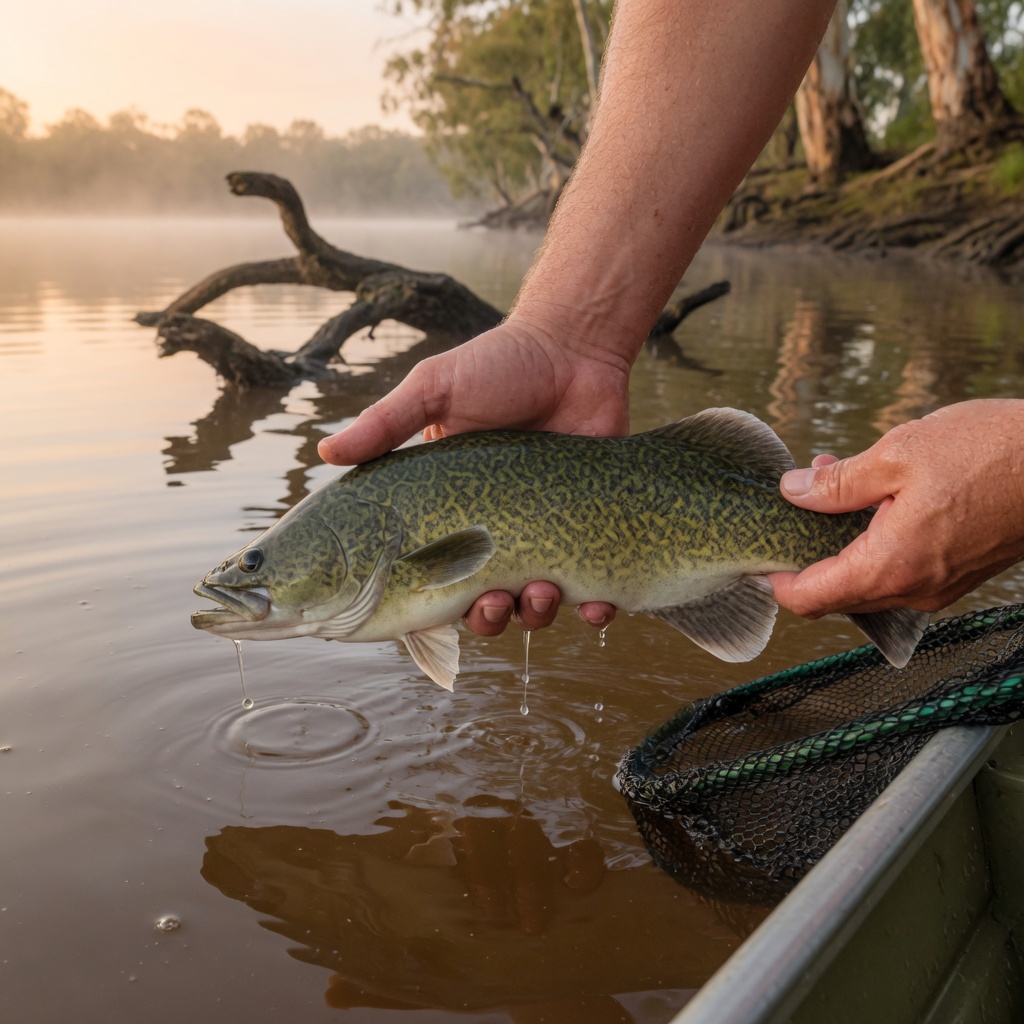
Support large fish horizontally with two hands: one under the head or gripping the lower jaw, the other supporting the belly ahead of the vent. Never hang a big cod, barramundi or bass vertically by the jaw, as the unsupported weight of the gut cavity can damage internal organs and the spine. Keep fingers well clear of the gills and eyes.
Aim for under 30 seconds of air exposure, and treat 10 to 15 seconds as the target for trophy fish. A practical routine: unhook the fish in the net in the water, get the camera ready, lift, take two or three quick shots, then return the fish. If the camera is not ready, the fish stays in the water.
Deeply Hooked Fish
If a hook is in the throat or gut and cannot be reached without damage, cut the leader as close as you safely can and release the fish with the hook in place. Attempting extraction usually causes more harm than leaving it. Deep hooking is far more common on bait than on lures, so if you are bait fishing, use circle-style hooks and check baits often rather than letting a fish swallow the offering.
Water Temperature and Seasonal Judgement
Warm water holds less dissolved oxygen, so summer releases in inland rivers and impoundments carry the highest risk. When surface temperatures climb through the high twenties, shorten fights, skip the photo of anything you are not keeping, and consider fishing dawn and dusk instead of the middle of the day. In spring, native cod and bass are on or near spawning routines that are protected by seasonal closures in most states, so check the current rules before you fish. Rules and closed seasons differ between states and change over time, so always verify limits with the relevant state or territory fisheries authority.
Reviving a Tired Fish
- Hold the fish upright in the water, facing into any current.
- Let water flow over the gills naturally; do not push the fish backwards and forwards, as that forces water the wrong way through the gills.
- Wait for the fish to grip with its tail and pectoral fins and swim off under its own power.
- In still water, walk the fish slowly forward or hold it beside a drifting boat.
Release Practice by Species
- Murray cod: heavy fish that need full belly support. Use a large rubber net or a padded cradle, keep them low over the water and avoid dropping them on hard surfaces.
- Australian bass: tough but often caught in warm, low-flow pools. Land quickly, avoid dragging them across sand or rocks, and release upstream of snags where they can hide.
- Golden perch: spiny dorsal and gill covers, so grip behind the head with a wet cloth. They tolerate handling well but still need short air time.
- Barramundi: razor-sharp gill plates cut hands and hands cut fish. Use a jaw grip plus belly support, and never lift a big one by the tail alone.
- Trout: the least tolerant of warm water and handling. Keep them wet, unhook in the net, and release without lifting where possible.
Fish You Should Keep Instead
Not every fish is a good release candidate. A fish that is bleeding heavily from the gills, one that has been out of the water too long in the heat, or one that will not stay upright after several minutes of revival is unlikely to survive. If it is a legal-sized species you are allowed to take, keep it and count it towards your bag rather than releasing a fish that will die. Equally, if you have your feed, stop fishing or switch to a lure and hook set-up that minimises harm.
Habitat, Access and the Bigger Picture
Releasing fish well is only part of looking after inland systems. Leave snags and fallen timber in place, avoid trampling bank vegetation and reed beds, take all line and packaging home, and never move live fish, plants or water between catchments. Clean and dry gear, boats and waders between systems to limit the spread of pests and disease. For more on species behaviour, seasons and techniques across the Murray-Darling Basin and coastal rivers, see our native freshwater fish and inland fishing guides.
Questions about a specific river, impoundment or species around Sydney and beyond? Contact Australian Fish Species on +61295585271 or at [email protected] during Mon–Fri: 09:00 – 17:00 (AEST), and we will point you to the right guide.

Navigation
See also
FAQ