Closed Seasons and Protected Species Across Australia
Why closures exist in the first place
Closed seasons are one of the oldest and most effective tools in Australian fisheries management. The logic is simple: protect fish while they are gathered in predictable numbers to spawn, and the population has a far better chance of replacing itself. Murray cod aggregate and breed in spring, Australian bass and estuary perch drop downstream to brackish water over winter, snapper form dense spawning schools on inshore reef, and barramundi stack up around river mouths and creek junctions before the wet. Those are exactly the moments when fish are easiest to catch and least able to absorb heavy pressure.
Alongside seasonal closures sit permanent protections. Some species are fully protected because their numbers have collapsed, their range is tiny, or they grow so slowly that any harvest is unsustainable. Grey nurse sharks, great white sharks, black cod, Queensland groper, trout cod, Macquarie perch in many waters, and eastern freshwater cod all fall into that broad category of "look, photograph, release". Sawfish, sea snakes, marine turtles and shorebirds are protected wildlife rather than fish, but anglers still encounter them and still need to know what to do.
The three layers of rules anglers deal with
- Time closures. Fishing for a species is prohibited for a set period, such as a spring closure on Murray cod across the Murray-Darling Basin or winter closures protecting bass and estuary perch in coastal rivers.
- Area closures. Marine park sanctuary zones, aquatic reserves, fish habitat areas, weir pools, fishways and stocked impoundments each carry their own restrictions. A species may be legal to keep 500 metres away and completely off limits where you are standing.
- Species protections. A no-take listing applies everywhere in that jurisdiction, all year, regardless of size. Possession of a protected species is generally an offence in itself, so identification matters enormously.
These layers stack. A trip out of Sydney can cross state waters, a marine park zone and a spawning closure in a single morning, so the honest answer to "can I keep this one?" is often "it depends where, when and what".
Identification is the practical skill
Most accidental breaches come down to misidentification rather than intent. Trout cod are routinely mistaken for small Murray cod, black cod for a large estuary rock cod, and juvenile Queensland groper for a legal-sized reef cod. Learn the diagnostic features rather than the general shape: the overhanging snout and dark eye stripe of trout cod, the banded juvenile pattern of black cod, the tail and fin markings that separate close relatives. Our species profiles and identification guides set out these features species by species, with the local names used by anglers in each state.
If you are not certain, treat the fish as protected. Keep it in the water, take a quick photo for later confirmation, and release it. That single habit prevents the vast majority of problems.
Releasing protected and out-of-season fish well
- Decide before you cast. If you are fishing a closure or an area holding protected species, rig for a fast release: single hooks, crushed barbs, heavier leader so the fight is short.
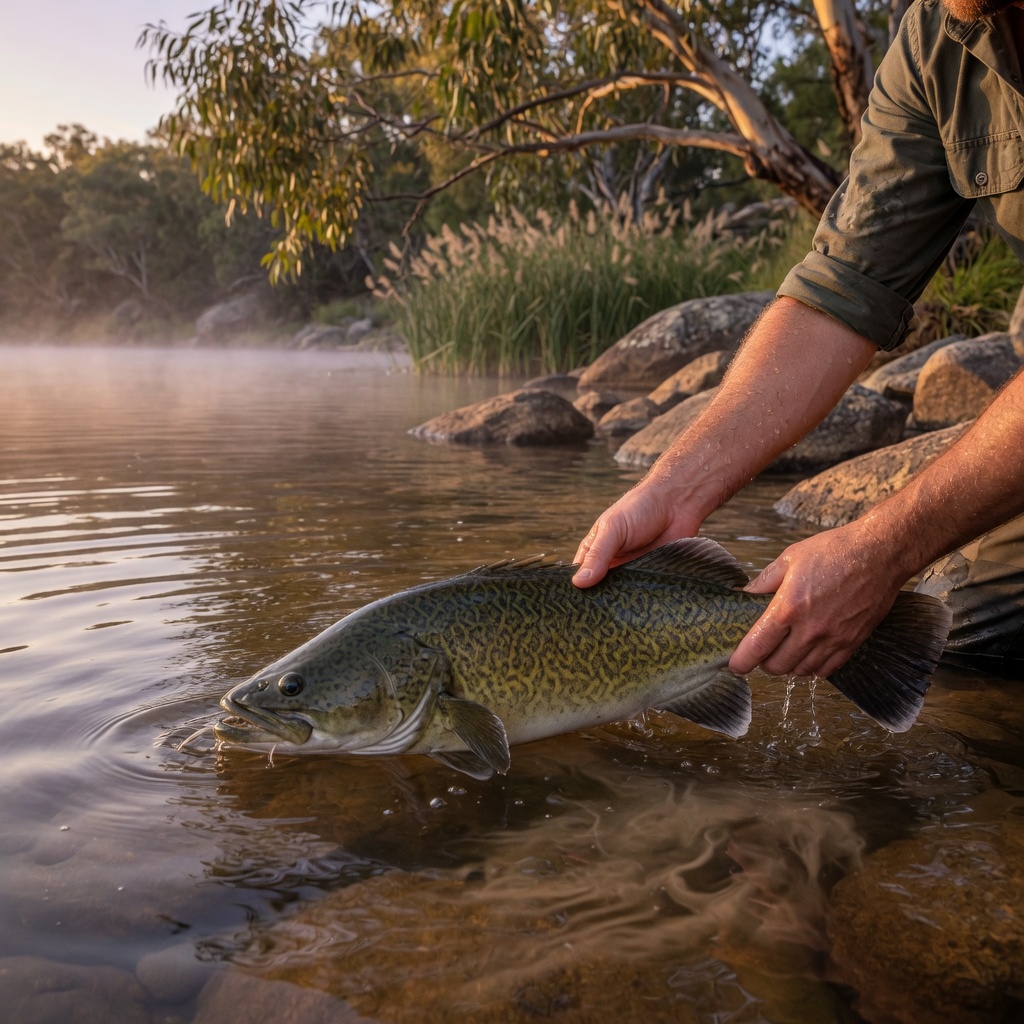
- Keep the fish wet. Support large fish horizontally, never hang them vertically by the jaw, and use a knotless landing net.
- Cut the leader on deeply hooked fish rather than digging for the hook.
- Vent or use a release weight for reef fish showing barotrauma after being lifted from depth.
- Revive before letting go. Hold the fish facing into gentle current until it kicks away under its own power.
How to check current rules before every trip
Closure dates, protected species lists, bag limits and size limits are set by each state and territory fisheries authority and they change. Dates can shift year to year, temporary closures are declared in response to fish kills or spawning conditions, and species can be added to protected lists. Nothing on this site replaces the current official rules for NSW, QLD, VIC, SA, WA, TAS, the NT or the Murray-Darling Basin.
A workable routine: check the relevant state fisheries website or its mobile app the week before you travel, note the closure dates for your target species, and confirm the zoning of any marine park or reserve you plan to fish. Carry a measuring device, know the minimum and maximum legal lengths that apply, and remember that possession limits can also cover fish in your freezer at home.
Fishing well inside the closures
Closed seasons are not lost time. Winter bass closures push anglers onto estuary bream, flathead and tailor. Spring cod closures are prime months for golden perch and yellowbelly in the same systems. A snapper closure is a chance to target kingfish, whiting or salmon. Planning around closures instead of against them usually means better fishing, less crowding and no risk of a fine.
Questions about a specific species or region? Contact Australian Fish Species on +61295585271 or [email protected] during Mon–Fri: 09:00 – 17:00 (AEST) and we will point you to the right authority and the right guide.

Navigation
See also
FAQ