Essential Fishing Knots for Australian Anglers
Why Knots Decide the Outcome
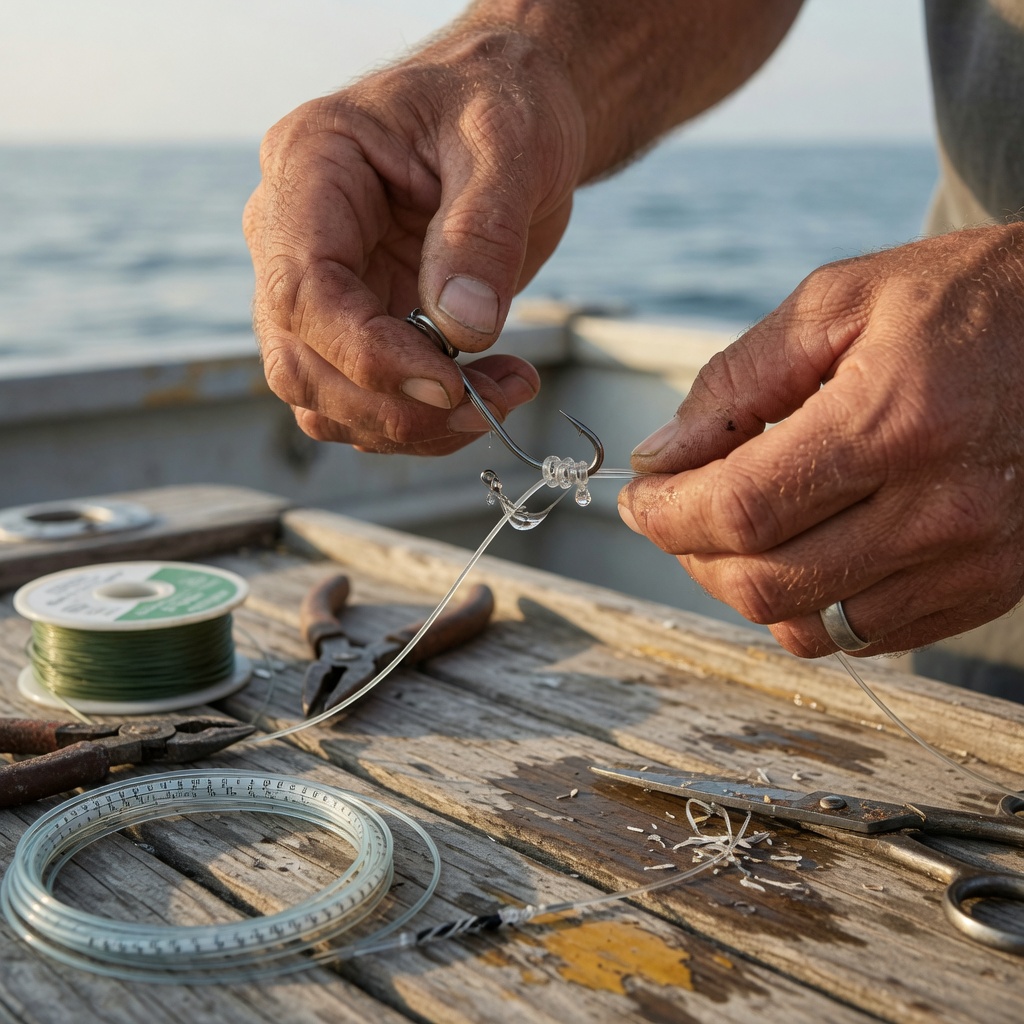
Every fish you land is connected to you by a handful of knots, and the knot is almost always the weakest point in the system. Braid, fluorocarbon and monofilament all behave differently under load, so the knot that holds beautifully on 6 kg mono may slip badly on 15 kg braid. Learning four or five knots properly beats knowing fifteen badly. Practise them at home with heavier line first so your fingers learn the sequence, then repeat until you can tie them in low light with cold hands and a rolling deck under you.
Two habits improve knot strength more than any change of pattern. First, lubricate with saliva or water before you pull the knot down, because friction heat weakens line as coils bed in. Second, seat the knot slowly and smoothly rather than with a sharp yank, then load test it against the rod before you cast.
Terminal Knots for Hooks, Swivels and Lures
- Uni knot (Duncan loop): the all-rounder. Reliable in mono and fluorocarbon, easy to tie, and it can be left slightly open as a loop knot to give small hardbodies and soft plastics more freedom of movement.
- Improved clinch: quick and compact for bream hooks, whiting long shanks and small lure eyes in lines up to about 10 kg. Five to seven wraps in lighter line, fewer in heavy.
- Snell: the classic bait knot for suicide and octopus patterns when chasing mulloway or snapper on flesh baits, because the pull comes in line with the hook shank.
- Lefty's loop or perfection loop: a fixed loop that lets a jighead or minnow swing freely, useful in the slow current of estuary flats and in inland freshwater systems where a natural drift matters.
Joining Braid to Leader
Most modern Australian rigs run thin braid to a mono or fluorocarbon leader, so the join has to pass through the rod guides smoothly. Choose the knot to suit the fishing rather than fashion.
- Double uni: the easiest dependable join. Four to six wraps on the braid side, three or four on the leader. Ideal for estuary bream, flathead and bass work with leaders up to about 12 kg.
- FG knot: a slim plait that runs through guides with almost no resistance, favoured for kingfish, tuna and Spanish mackerel where long casts and heavy leaders meet. It takes practice and needs a locking series of half hitches to finish.
- Slim beauty or Albright: handy for stepping up to very heavy shock leaders on beach and rock outfits, or when joining wildly different diameters.
Knots for Rigs and Droppers
Paternoster rigs for whiting, snapper and reef fish rely on strong dropper loops. A three-turn dropper loop is quick and holds well in mono. For running sinker rigs, a simple uni to the swivel above a bead protects the knot from the sinker hammering it. On offshore game gear, crimps often replace knots entirely in heavy leaders because they hold more consistently at high drag settings.
Common Mistakes to Avoid
- Tying braid directly to a lure or hook with a mono knot: braid is slick and needs pattern designed for it, or a leader.
- Trimming tag ends flush, which allows some knots to creep under load. Leave 2 to 3 mm.
- Ignoring line that has been through the guides for weeks. Re-tie leaders after every session and inspect the last metre for chafe from oyster racks, reef and rock ledges.
- Rushing the seating pull, which burns line and hides the damage until a fish finds it.
Safety and Fish Care
Reliable knots are also a welfare issue. A break-off leaves a fish trailing hooks and line, so sound connections support the catch and release practices covered throughout Australian Fish Species. Carry sharp scissors or clippers for cutting braid, and never test heavy knots by wrapping line around your hand, particularly on rock platforms or in a moving boat.
Anglers around Sydney face everything from oyster-lined estuary pylons to blue water game fishing, so build a small kit of leader spools in a range of breaking strains and practise the same knots across all of them. Questions about a specific rig or species application can be sent to [email protected] or raised by phone on +61295585271 during Mon–Fri: 09:00 – 17:00 (AEST).

Navigation
See also
FAQ