Handling Big Fish: Nets, Grips, Photos and Quick Releases
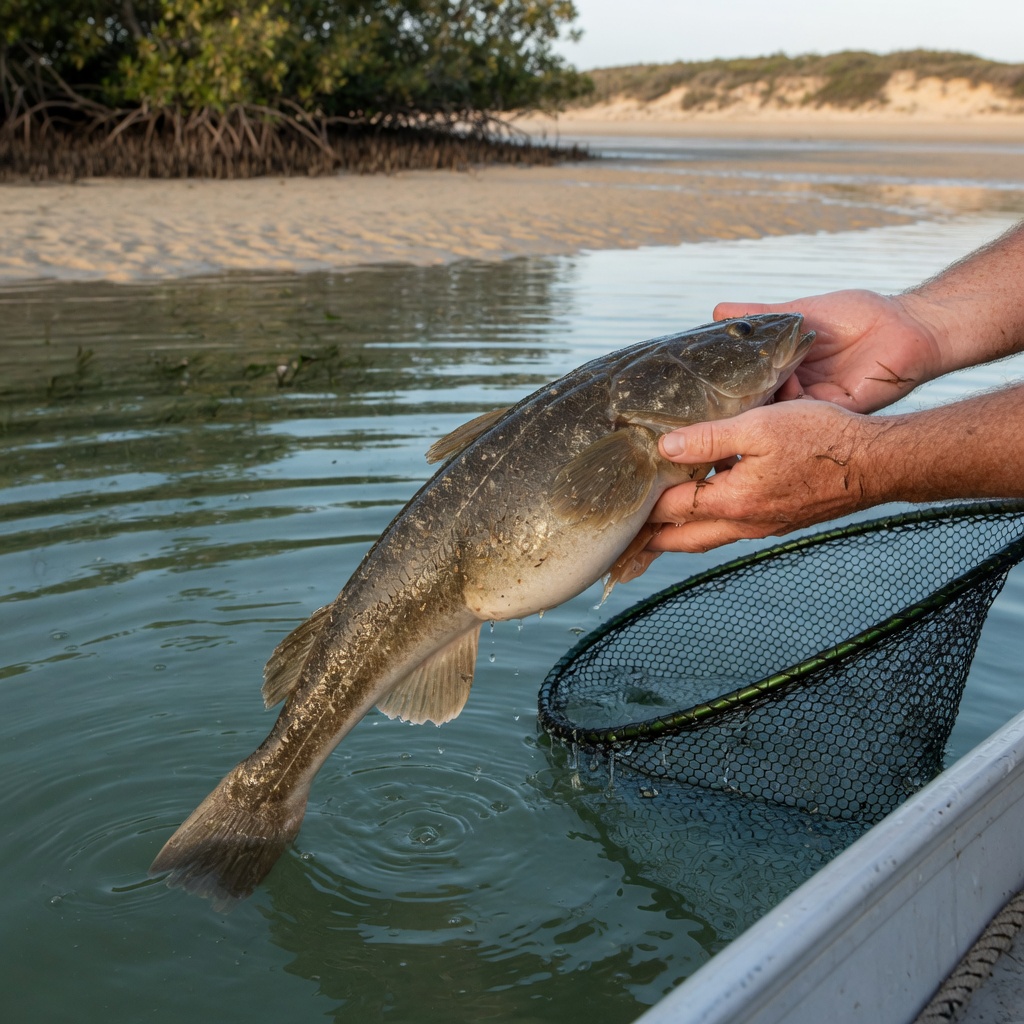
Why Handling Matters More Than the Fight
Most fish that die after release do not die from the hook - they die from the twenty seconds spent on hot sand, a dry deck or a rock ledge while somebody hunts for a phone. A 70 cm dusky flathead from Botany Bay, a metre-plus mulloway off Sydney Harbour or a big Australian bass from a Hawkesbury tributary all carry years of growth and, in the case of large flathead and jewfish, most of the breeding value of the population. Handling them well is the cheapest conservation action any angler can take.
The principle is simple: shorten the fight where you can, keep the fish wet, support its body weight, and get it back before it stops kicking. Everything below is just detail on how to do that with the gear you already carry.
Nets, Slings and Landing Choices
Your landing tool sets up everything that follows. Choose it for the fish, not for the boot space.
- Knotless rubber or rubberised mesh nets - the default for estuary work on bream, flathead, whiting and bass. Knotted nylon strips slime and scales and tangles trebles.
- Deep, wide nets for kingfish and snapper from a boat. A shallow net lets a hot fish bounce out over the rim and hit the deck.
- Weigh slings or wet cradles for anything over roughly 5 kg you actually want to measure. Never hang a big snapper, mulloway or barramundi vertically by the jaw - the internal organs are not built to carry that load.
- Lip grips are fine for control and for keeping fingers out of a mangrove jack's mouth, but treat them as a handle, not a hoist. Support the belly with your other hand at all times.
- Gaffs belong only on fish you are keeping - typically pelagics such as tuna, Spanish mackerel and tailor destined for the esky.
Off the rocks, a net is often impossible and a wash-up landing is the reality. Time it with the swell, never turn your back on the water, and read our safety notes before you plan any ledge session in heavy conditions.
Grips: Where to Hold, Where Not To
Different species need different hands. Knowing the body plan first makes this easier, which is why identification and handling go together - see our species profiles and identification guides for the features to look for.
- Flathead - one hand under the head from below, thumb behind the gill cover, avoiding the sharp opercular spikes. Support the belly. Do not squeeze the gut cavity.
- Bream, snapper and whiting - cradle horizontally with wet hands. Snapper have strong crushers; keep fingers clear of the mouth.
- Barramundi, bass and Murray cod - lip grip or thumb in the jaw with the other hand under the pectoral region, held horizontally. Big cod should be supported over the water or on a wet mat only.
- Mulloway and kingfish - two hands, horizontal, brief. Both are heavy-bodied and bruise easily against decks and rocks.
- Mackerel, tailor and tuna - assume teeth or razor gill plates. Use a wet towel and control the head.
- Never hold a fish by the gills or eye sockets if you intend to release it, and never let it flap on dry, hot surfaces.
Photos in Under Twenty Seconds
Plan the photo before the fish is landed. Camera unlocked, mate briefed, wet hands, fish still in the net in the water.
- Unhook in the net, in the water, with long-nose pliers or a hook remover.
- Take a breath and hold it - when you need air, so does the fish. That is your timer.
- Lift low over water or a wet mat, support head and belly, keep the fish horizontal.
- Shoot a burst rather than fiddling with framing. Two or three frames is plenty.
- Return the fish head-first into the water and hold it upright until it swims off under its own steam.
Measure on a wet brag mat or bump board rather than dangling on scales. If the fish must be kept for a legal length check, do it fast and remember that size and bag limits differ by state and change over time - always confirm the current rules with the relevant state or territory fisheries authority before you keep anything.
Deep-Water Releases and Barotrauma
Snapper, morwong and other reef species brought up from beyond roughly 20-30 m often show barotrauma: a bulging gut, protruding eyes or an inability to swim down. These fish will not survive floating on the surface. Carry a release weight or descender and send the fish back to depth, or use a properly placed venting tool if that is the accepted method in your area. Decide in advance which fish you will keep from deep water, because repeated deep releases stack the odds against survival.
Quick Checklist for Your Kit
- Knotless rubber net and a folding weigh sling
- Long-nose pliers, side cutters and a hook-out tool
- Wet brag mat or measuring board
- Lip grips, used with belly support
- Release weight or descender for offshore work
- Barbless or crushed-barb single hooks for catch-and-release sessions
- A bucket of water to keep the mat and your hands wet
Handle them well and the same fish is there next season, often in the same snag or on the same drop-off. For questions on gear or local conditions around Sydney, contact Australian Fish Species on +61295585271 or [email protected] during Mon–Fri: 09:00 – 17:00 (AEST).

Navigation
See also
FAQ