How Bag Limits and Size Limits Work and How to Measure Fish
Why limits exist and who sets them
Bag limits and size limits are the backbone of recreational fisheries management in Australia. They spread the catch across many anglers, protect fish that have not yet spawned, and give heavily fished species around cities like Sydney a chance to keep replacing themselves. Every state and territory sets its own rules, so the legal length for a bream in NSW may differ from the rule applied to the same species in Victoria or South Australia.
Because limits, closures and licence requirements are reviewed and changed over time, Australian Fish Species explains how the rules are structured rather than publishing a number you might rely on months later. Before you fish, check the current limits with the relevant state or territory fisheries authority, or the pocket guide and app they publish for anglers.
The four kinds of limits you will meet
- Bag limit (daily limit) — the maximum number of a species you may take in a day. Some species also sit inside a combined limit, where several similar species share one total.
- Possession limit — the maximum you may have in your possession at any time, including fish in the freezer at home, at a campsite or in transit. This is what stops multi-day trips accumulating far more than a daily bag.
- Size limit — a minimum legal length, and for some species a maximum length as well. Slot limits (a minimum and a maximum) protect big, highly fecund breeders in species such as barramundi and Murray cod.
- Closures — seasonal closures during spawning runs, area closures such as marine parks and sanctuary zones, and gear restrictions on nets, traps and lines.
How to measure a fish correctly
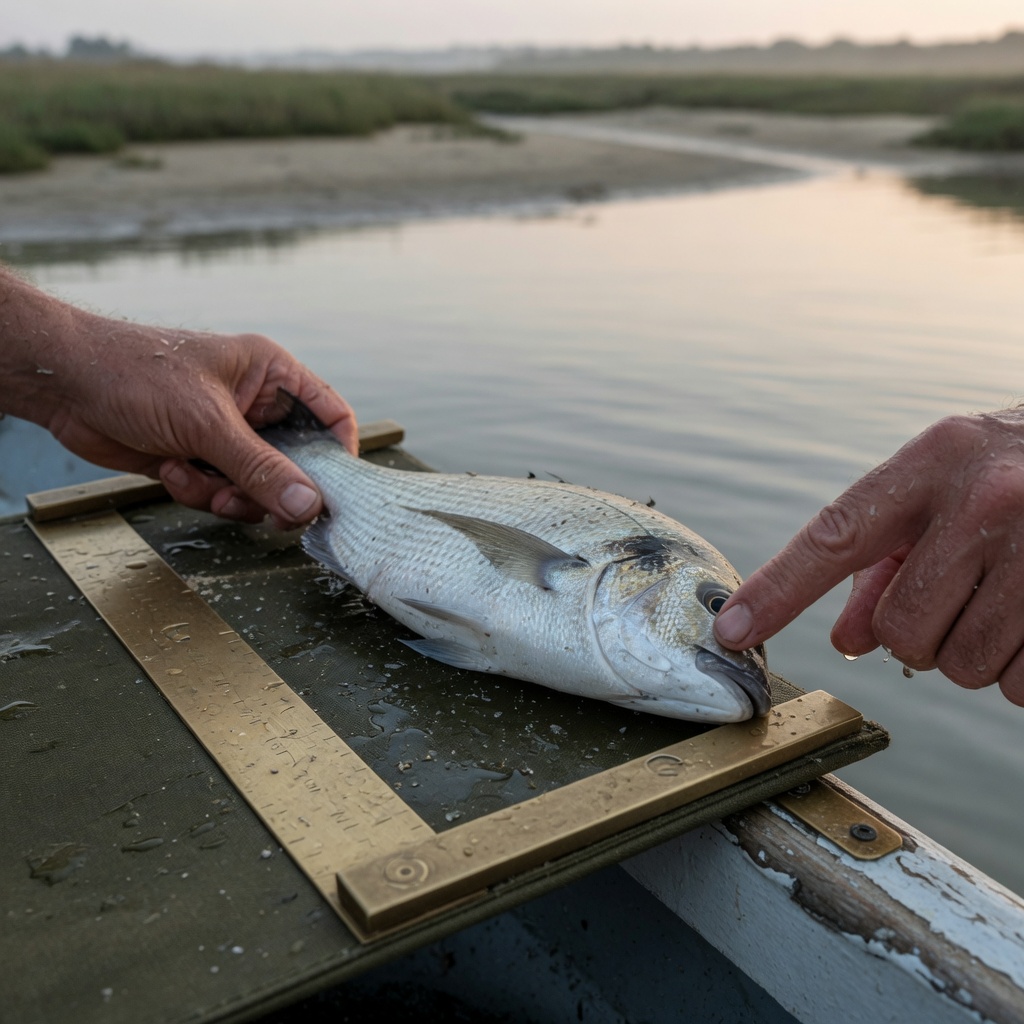
Most Australian jurisdictions measure total length: from the tip of the snout, with the mouth closed, to the tip of the tail. Where the tail is forked, the accepted method is usually to squeeze the tail lobes together to the longest point rather than measuring to the fork. Some species are measured differently, so read the species notes in your state guide.
- Carry a rigid brag mat or measuring board and wet it before use — a wet surface protects the fish's slime coat.
- Lay the fish flat on its side with the snout hard against the zero end. Do not stretch the fish or bend the tail.
- Read the mark at the longest point of the tail. If the fish is borderline, treat it as undersize and release it.
- Measure before you place a fish in the esky or bag, not after — fish shrink slightly once chilled.
Species measured another way
Crustaceans and some shellfish are not measured nose to tail. Rock lobster are measured across the carapace, mud crabs and blue swimmer crabs across the widest part of the shell, and abalone across the longest shell dimension. Egg-bearing (berried) females are protected in most states and must be returned immediately.
Handling and releasing undersize or unwanted fish
A legal release only helps the fishery if the fish survives. Keep the fish in the water where you can, use wet hands or a knotless landing net, support the belly of larger fish and avoid gripping the gills. Long-nose pliers, a hook remover and crushed or single barbless hooks all shorten handling time. Fish brought up from depth may need venting or a release weight to deal with barotrauma — see our notes on catch and release for the detail.
Circle hooks on bait rigs reduce deep hooking, which matters when you are sorting through undersize snapper or flathead to find a keeper. If a fish is bleeding heavily or exhausted, it may be a better outcome to keep it as part of your bag, if it is legal to do so, than to release a fish that will not swim away.
Licences, records and staying on the right side of the rules
Licence requirements vary: some states require a recreational fishing fee or licence for all fishing, others only for freshwater or specific fisheries, and concessions may apply. Keep proof of your licence with you, whether printed or on your phone. It also pays to record what you keep — a simple note of species, number and location makes a compliance check straightforward and helps you build your own picture of seasonal patterns.
Practical habits that keep you compliant: know the limits for your target species before you launch, keep fish whole until you get home unless filleting at sea is expressly allowed, do not mix your catch with someone else's bag, and never take a fish you cannot identify. If you fish across state borders or on the Murray, remember the rules can change with the waterway, not just the state line.
Where to check current rules
Treat every number you read online, including in older forum posts and printed guides, as out of date until you confirm it. State and territory fisheries agencies publish the authoritative limits, closure dates and licence conditions, and they update them as stock assessments change. Our broader overview of fishing rules, licences and limits explains the structure of these frameworks so the official guides make sense at a glance.
Questions about this guide can go to [email protected] or +61295585271 during Mon–Fri: 09:00 – 17:00 (AEST). Australian Fish Species provides general information only and is not a substitute for the current regulations issued by your state or territory fisheries authority.

Navigation
See also
FAQ