How Tides Create Feeding Windows in Estuaries and on Reefs
Why Tide Matters More Than the Time of Day
Most anglers plan a session around daylight or spare hours, but fish plan their day around moving water. A tide is simply a slow pulse of energy that shifts food, oxygen and cover through an estuary or across a reef. When that pulse is strong, prey is pushed into predictable places and predators move up to feed. When it stalls at the top or bottom of the tide, the buffet closes and bites often go quiet for an hour or more.
Around Sydney the daily pattern is semi-diurnal: roughly two high tides and two low tides each day, with about six hours of run each way. The practical takeaway is that every day contains four periods of strong current and four periods of slack. Your job is to be standing on the right structure when the water starts to move, not to arrive at first light and hope.
The Mechanics of a Feeding Window
A feeding window opens when three things line up: current, structure and food. Current does the work of delivering prawns, nippers, whitebait and small crabs; structure creates the eddy, pressure edge or ambush point where a predator can hold without burning energy; food concentrates in the seam between fast and slow water.
- First of the run: the first 60 to 90 minutes after the tide turns often produces the sharpest bite, because bait that settled during slack water is suddenly lifted and moved.
- Mid-tide flow: maximum current speed, best for drifting baits, swinging soft plastics and fishing deep holes and bridge pylons.
- Last of the run: water draining off flats and out of creek mouths funnels prawns and small fish into narrow choke points.
- Slack water: generally the slowest period, though it can be the safest time for bar crossings and for anchoring on reef edges.
Reading Estuary Tides
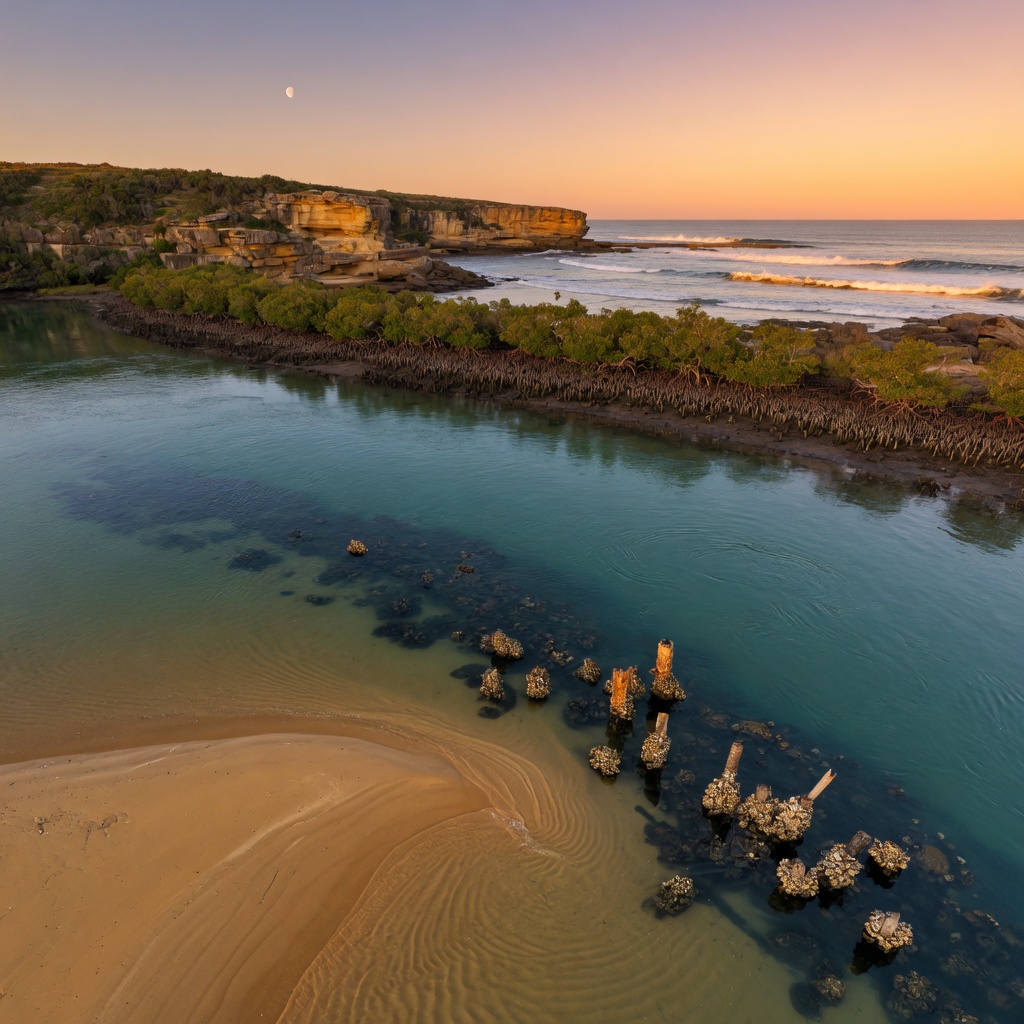
In an estuary, think of the system as a set of drains. On the ebb, water leaves the shallow sand and mud flats, mangrove edges and side creeks, and everything living there is forced into deeper channels. That is why the last two hours of the ebb around a creek mouth, drain or oyster rack can be so productive for bream and flathead, which sit facing the flow and wait.
On the flood, the process reverses. Warm shallow water is refilled and fish push up onto flats, weed beds and sand banks to hunt nippers, worms and crabs. Whiting are a classic flood-tide target on shallow banks, often in less than a metre of water. Mulloway tend to favour bigger tidal movement around deep holes, bridges and rock walls, especially where a night high tide coincides with a change of light.
Estuary Timing Checklist
- Pick structure first: a drain, point, bank edge, bridge, rock wall or weed line.
- Work out which tide direction pushes food past that structure.
- Arrive 30 minutes before the flow builds and stay through the strongest hour.
- Move with the tide rather than waiting it out, following the same edge upstream or downstream.
Reef and Offshore Tides
Out on inshore reefs the same principles apply, but the scale is larger. Current bends around headlands, bommies and reef edges, creating upwellings and pressure lines that hold bait balls. Snapper, kingfish and coral trout position themselves on the current-facing side of structure or in the calm pocket behind it. If your sounder shows bait stacked on one end of a reef, that is usually the up-current end.
Two practical signs matter more than the printed tide table when you are offshore. First, watch your anchor rope or drift speed: a drift of roughly 0.5 to 1.5 knots often suits bottom fishing, while faster water suits trolling or heavier sinkers. Second, watch the bait. If the school lifts off the bottom or spreads out, feeding is usually starting.
Moon Phase, Weather and Barometric Pressure
Tidal range is driven by the moon and sun. Around the new and full moon, spring tides produce bigger ranges and faster current; around the quarter moons, neap tides are gentler. Neither is universally better. Big spring tides can supercharge a short window but also dirty the water and make shallow flats unfishable. Neap tides suit clear-water sight fishing and long, steady sessions.
- Falling barometer ahead of a front often triggers a strong short-term bite.
- Steady high pressure with light wind suits finesse presentations and clear water.
- Wind against tide creates a chop that can improve surface bites but makes boat control harder.
- Rain and runoff push freshwater and food into estuaries, often concentrating fish on salt wedges lower in the system.
Change of light stacked on top of a moving tide is the strongest combination in most Australian estuaries. Dawn or dusk with two hours of run either side gives you the best of both.
Building a Simple Bite Log
Prediction improves fastest when you record what actually happened. For each session note the date, location, tide times and height, moon phase, wind, water clarity and the exact clock times of every bite. After a dozen sessions on one system, patterns emerge that no generic table can give you, such as a particular point that only fires on the last hour of the ebb with a westerly behind it.
Safety Comes Before the Bite Window
Chasing a tide should never override basic caution. Strong ebb tides against a swell make coastal bars dangerous, and rising water can strand anglers on rock ledges or sand banks. Always check the marine forecast and tide height before you leave, wear a life jacket on rocks and in small boats, tell someone your plan, and be prepared to fish a lesser spot rather than a risky one. Seasons in the Southern Hemisphere sense also matter: winter westerlies and summer nor-easters change which side of an estuary is fishable and comfortable.
For advice specific to your local system, contact Australian Fish Species at [email protected] or +61295585271 during Mon–Fri: 09:00 – 17:00 (AEST). Remember that bag limits, size limits and closures vary by state and change over time, so verify current rules with the relevant state or territory fisheries authority before you keep a fish.
Navigation
See also
FAQ