Live Bait Rigging for Mulloway, Kingfish and Snapper
Why live bait works on these three species
Mulloway, kingfish and snapper are all opportunistic ambush feeders that key in on the vibration, flash and panic of a struggling baitfish. A live bait presented naturally will often out-fish lures and dead baits in dirty water, on slack light and around structure where fish hold tight and refuse to chase. Around Sydney the same three or four bait species — yellowtail scad (yakkas), slimy mackerel, squid and mullet — cover nearly every situation from the harbour to the offshore reefs.
The trick is not just catching bait, but rigging it so it swims properly, stays alive, and sets a hook cleanly when a fish eats it. Poor rigging is the most common reason anglers fish for hours with a dead, spinning bait and no bites.
Choosing and keeping the right bait
- Yellowtail scad — the all-rounder. Tough, available around wharves and moorings, and eaten by kingfish, mulloway and snapper alike.
- Slimy mackerel — fantastic for kingfish and big mulloway, but soft-scaled and needs gentle handling.
- Squid — the premium mulloway and snapper bait, especially at night over reef edges and deep estuary holes.
- Mullet and herring — estuary staples for mulloway on the run-out tide.
- Small bonito and frigate mackerel — for hooligan kingfish around offshore islands and pinnacles.
Keep baits in a round or oval tank with steady aeration and regular water changes. Wet hands, no dry decks, and never overcrowd the tank. A bait that has been dropped or squeezed will swim on its side and get ignored.
Core live bait rigs
Single pin rig (nose or shoulder)
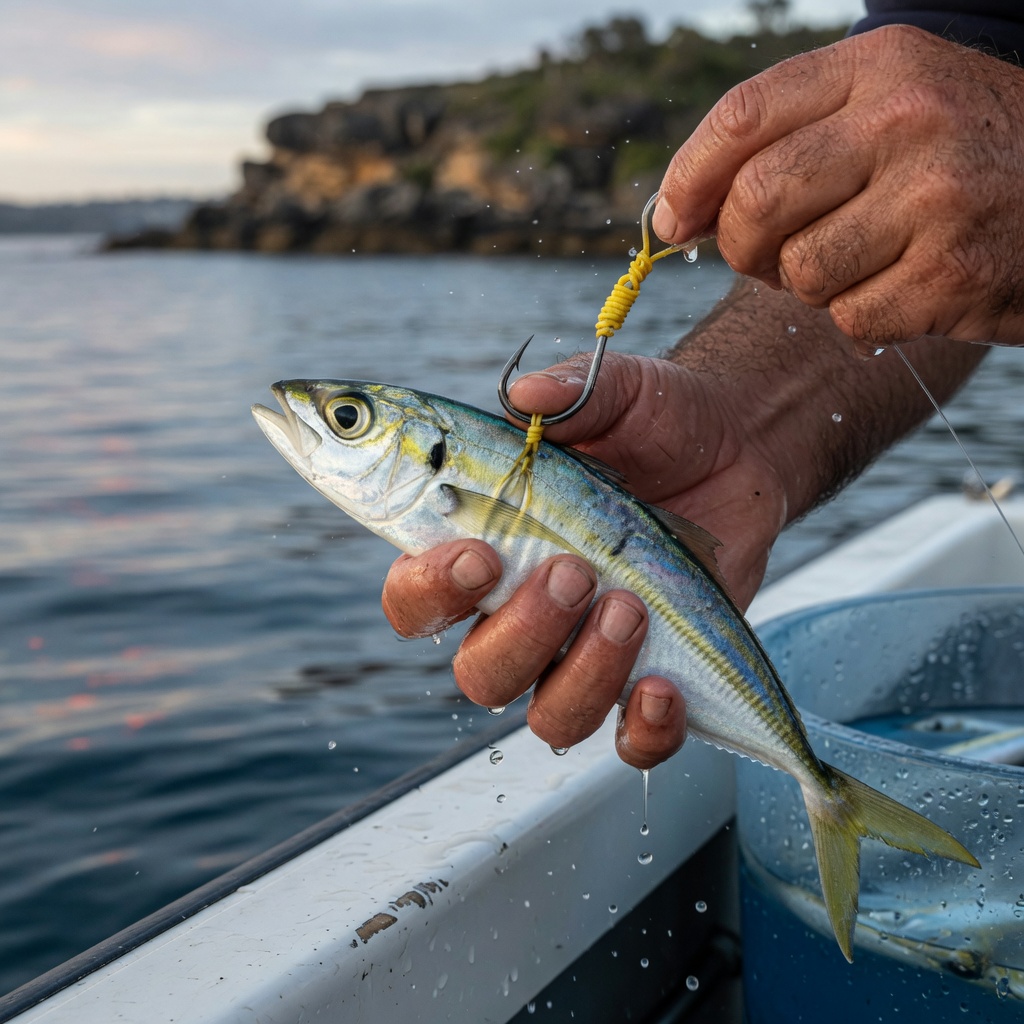
One hook through the nostrils or just behind the shoulder above the lateral line. Simple, quick, and ideal for slow trolling or drifting scad and slimies for kingfish. Nose-hooked baits swim forward well when trolled; shoulder-hooked baits swim down and away when fished on a slack line under a float.
Two-hook snelled rig
The go-to mulloway rig for larger mullet and tailor-sized baits. Snell two hooks so the lead hook sits at the shoulder and the trailing hook near the tail. Mulloway often engulf a bait side-on, and the second hook dramatically improves the strike rate on big baits.
Bridle rig
Used with a bait needle and a short loop of dacron or a rubber band through the eye socket, then twisted onto the hook. Because the hook sits outside the bait, the gape is fully exposed and hook-ups are excellent. Bridle rigs are best for slow trolling and long soaks on kingfish and heavy game work.
Drift rig for snapper
A running sinker above a swivel with a metre or more of fluorocarbon leader and a single hook through the nose of a small live bait or squid. Fished on a slow drift over broken reef in 20–60 m, this presentation lets snapper pick the bait up and move off without feeling weight.
Hooks, leaders and terminal tackle
- Hooks: 4/0–6/0 circles or suicides for snapper and school mulloway; 7/0–9/0 for large mulloway baits; 6/0–9/0 heavy-gauge live bait hooks for kingfish.
- Leader: 20–30 kg fluorocarbon for mulloway around bridge pylons and rock ledges; 30–60 kg for kingfish near structure; 15–25 kg for snapper where finesse matters.
- Weight: use the lightest sinker that holds the strike zone. Unweighted or lightly weighted baits swim far more naturally.
- Circle hooks: do not strike. Let the line load up and lift steadily — better hook-up rates in the jaw hinge and far better survival for released fish.
Timing: tide, light and moon
Live baiting rewards patience at the right moment rather than long hours at the wrong one. Mulloway favour the last two hours of the run-out and the change, particularly at night around the new and full moon in deep estuary holes and along beach gutters. Kingfish switch on with moving current over pinnacles and headland washes, usually in the first hours of light. Snapper feed hardest in low light and on the tide change over reef edges, with autumn and winter the standout seasons in southern waters.
Match your bait size to the mood of the fish. If baits keep getting scaled or nipped without a hook-up, downsize; if pickers destroy everything, go bigger and tougher.
Handling, release and safety
Fish taken from deeper water — particularly snapper and mulloway from 30 m or more — can suffer barotrauma. Carry a release weight or venting tool, minimise time out of the water, and support big fish horizontally. If you are rock-fishing live baits for mulloway or kingfish, wear a lifejacket and cleated boots, watch the swell for a full set before committing to a ledge, and never fish a ledge alone.
Bag limits, size limits and closures for all three species vary by state and change over time. Use this guide for technique only and confirm current rules with the relevant state or territory fisheries authority before you keep a fish.
Where to next
Getting your identification right underpins every rule and every rig choice, so it is worth reading our fish species profiles and identification notes alongside this guide. For questions about a specific rig or region, contact Australian Fish Species at [email protected] or +61295585271 during Mon–Fri: 09:00 – 17:00 (AEST).
Navigation
See also
FAQ