Mahi Mahi Around FADs and Floating Debris
Identifying Mahi Mahi
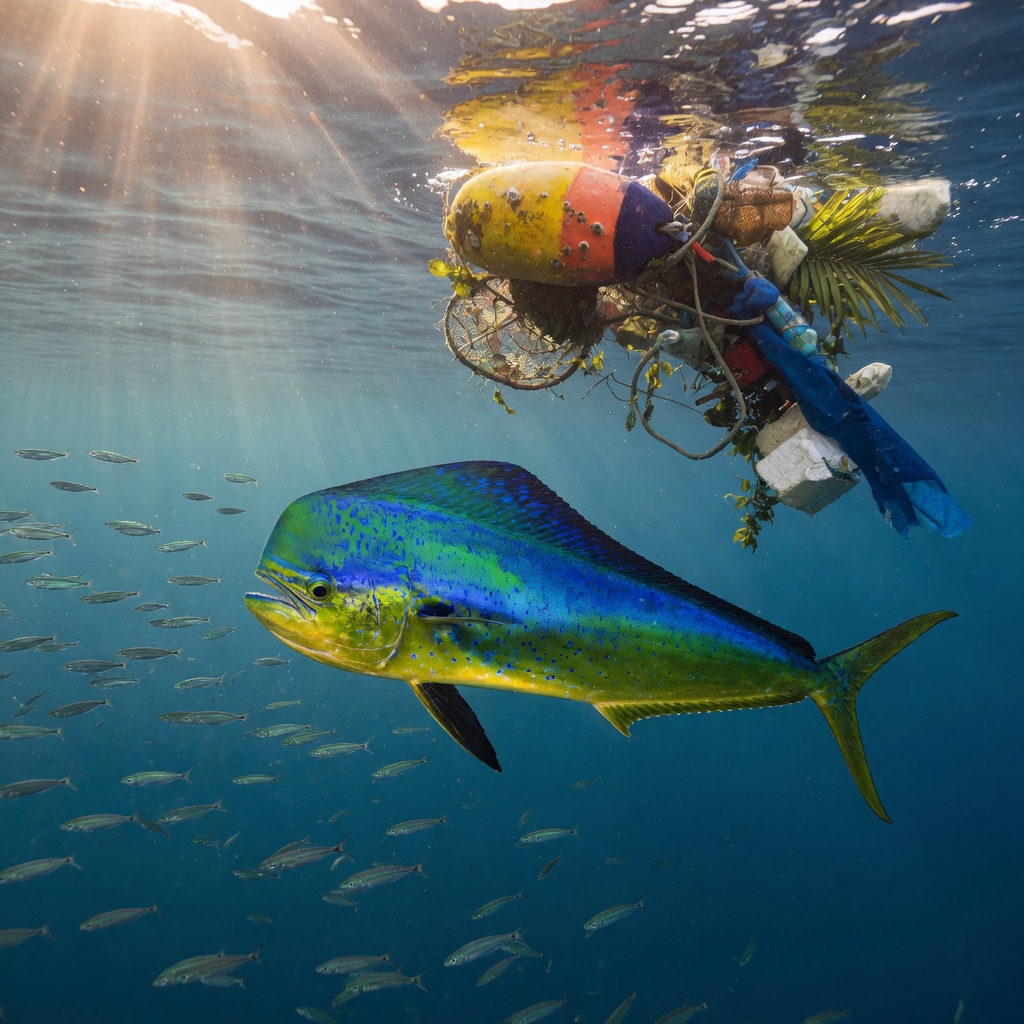
Mahi mahi, known locally as dolphinfish or dollies, are unmistakable once you see one alongside the boat. Electric blues and greens run along the flanks, the belly glows gold to yellow, and small dark spots scatter across the body. Bulls (mature males) develop a tall, blunt forehead, while cows keep a smooth, rounded profile. The dorsal fin runs almost the full length of the back, and the deeply forked tail explains the blistering speed and the acrobatic jumps that make them so popular with anglers around Sydney.
Colour fades quickly after capture, so identification in the esky is easier by shape: a compressed, tapering body, long dorsal and forked tail. Small fish under about 60 cm are often called rats and travel in tight schools, while larger fish tend to pair up or hold in loose groups. Growth is extremely fast and lifespan short, which is why fish of very different sizes can appear in the same season.
Why FADs and Floating Debris Work
Mahi mahi are pelagic wanderers, but they are strongly drawn to structure floating in open water. Fish Aggregating Devices (FADs) deployed by several state fisheries agencies do exactly what the name suggests: they create shade, attract baitfish and small crustaceans, and hold predators nearby. Natural equivalents work just as well, including drifting timber, palm fronds, kelp mats, floating rope, weed lines and even a single plank on a current edge.
The pattern to look for is the join between warm blue current water and cooler green inshore water. Debris collects along these seams, and so does bait. In summer and autumn the East Australian Current pushes warm water down the NSW coast, and the mahi mahi ride with it. Water above roughly 21 to 22 degrees is a useful starting point, with the best sessions often on clean blue water carrying scattered weed.
Reading the Signs
- Birds: terns and shearwaters working a small patch usually mean bait pushed up from below.
- Colour change: a defined line, often with foam or weed strung along it.
- Debris: anything floating deserves a look, even if it seems too small to matter.
- Flying fish: showering flyers are a strong indicator of feeding pelagics.
Approach and Presentation
Do not motor straight over the top of a FAD or a log. Approach from downwind or down-current, shut down well short, and drift in. Cast unweighted pilchards, slimy mackerel strips or garfish beyond the structure and let them sink naturally. A small amount of berley, cubed pilchard rather than a heavy trail, will often bring the school out from the shade and up the trail towards the boat.
Once one fish is hooked, keep it in the water. Mahi mahi are intensely competitive, and a hooked fish holds the school. That is when a second and third angler cast, which is how you turn one bite into a session. Small metal slugs, soft plastics on 1/4 to 1/2 oz jig heads, and small skirted lures trolled past the edge of the structure all produce.
Rigs and Tackle
- Spin outfits: 4000 to 6000 size reels, 15 to 30 lb braid, 20 to 40 lb fluorocarbon leader.
- Hooks: 3/0 to 5/0 circle or suicide patterns on floating baits, no wire unless mackerel are thick.
- Trolling: small skirts and swimming lures at 6 to 7 knots along weed lines and past FADs.
- Extras: long-handled net, gaff for larger bulls, and a dedicated bin, because a live dolphinfish in the cockpit is chaos.
Seasons and Timing
Off Sydney the run typically builds from December, peaks in February and March, and can hold into May in a warm year. Northern QLD and the NT see mahi mahi over a longer window. Early morning is usually best, partly because light winds make debris easier to spot, and partly because the fish feed hard before the sun climbs. A rising barometer after a few settled days with a light nor-easter is a classic setup. Always check the marine forecast before committing, as offshore work leaves little room for optimism about wind and swell.
Handling, Rules and Conservation
Mahi mahi are superb eating but bruise easily, so bleed and ice fish immediately. They rarely suffer barotrauma because they are caught near the surface, which makes release straightforward: keep them wet, support the body, and avoid gripping the gills. Take what you need for a feed and let the rest go, particularly the small schooling rats.
Size and bag limits for dolphinfish, and any rules covering FADs themselves, differ by state and change over time. Confirm current limits with the relevant state or territory fisheries authority before you launch. For more on offshore identification and related pelagic targets, see our fish species profiles and identification guides. Questions about local conditions can be sent to [email protected] or raised by phone on +61295585271 during Mon–Fri: 09:00 – 17:00 (AEST), and Australian Fish Species updates its seasonal notes as each summer run develops.
Navigation
See also
FAQ