Paternoster, Running Sinker and Fluorocarbon Leader Rigs
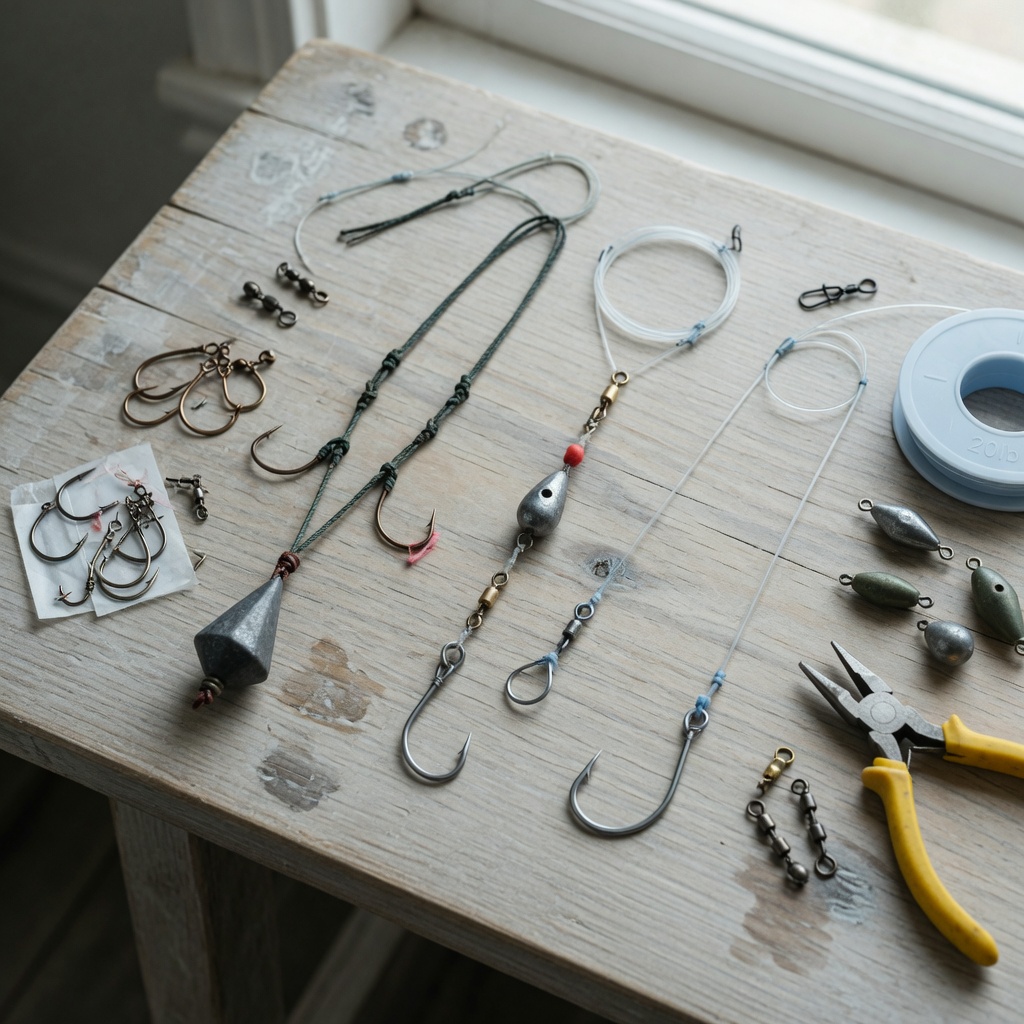
Three rigs that cover most Australian bait fishing
If you only ever learned three bait rigs, the paternoster, the running sinker and a simple fluorocarbon leader would cover the majority of fishing around Sydney and the wider Australian coast. Each one solves a different problem: keeping baits off a snaggy bottom, letting a wary fish take line without feeling weight, and hiding the connection between braid and hook. Understanding why each rig works lets you adjust it on the water instead of blindly copying a diagram.
All three are built from the same handful of components — hooks, swivels, sinkers, leader material and a couple of reliable knots. Buy good hooks and good leader before you buy anything else; a rusty hook or nicked leader loses far more fish than a cheap rod ever will.
The paternoster (dropper) rig
A paternoster suspends one or two baits above a sinker that sits on the bottom. It shines wherever the bottom is rough, weedy or holds structure: offshore reef, deep estuary holes, breakwalls and rock ledges. Because the sinker is at the very bottom of the rig, it takes the snag first and can be left light enough to break off cheaply.
How to tie it
- Take about 80–100 cm of leader — 15–25 kg for reef work, 6–10 kg for estuary species.
- Tie a small loop (a dropper loop or a simple overhand loop) 20–25 cm up from one end, and a second loop another 25–30 cm above that if you want two baits.
- Attach hooks to the loops, either snelled onto short 10 cm droppers or looped straight through.
- Tie a small swivel or loop to the tag end for the sinker, and a loop or swivel at the top to join your mainline leader.
When it works best
- Reef and offshore — snapper, morwong, pearl perch, coral trout: circle hooks 4/0–7/0, enough lead to hold bottom in the current.
- Deep estuary and harbour holes — trag, flathead, bream on a dropping tide.
- Beach and rock — a single-dropper version keeps a strip bait clear of the wash and weed.
Keep droppers short so hooks cannot tangle around the main stem. If baits keep spinning and twisting the rig in current, shorten them further and use a flatter, less resistant bait such as a strip of squid or slimy mackerel fillet.
The running sinker rig
The running sinker (or running ball) rig has the sinker sliding freely on the line above a swivel, with a leader and hook below. When a fish picks up the bait and moves off, line runs through the sinker rather than dragging weight. That single detail is why it dominates in estuaries for bream, whiting, flathead and mulloway, and on the beach for salmon and tailor.
Standard build
- Thread a ball or bean sinker onto your mainline or leader.
- Tie on a small swivel to stop the sinker sliding down.
- Add 40–120 cm of fluorocarbon leader below the swivel, then the hook.
Longer leaders give a more natural bait drift in clear water; shorter leaders give better bite detection and fewer tangles in current or when casting heavy sinkers. As a starting point, run 60 cm for estuary bream and whiting, 1 m or more for spooky flats fish, and up to 1.5 m for mulloway drifting live baits.
Sinker weight discipline
Use the lightest sinker that still holds your position. Overweighting is the single most common bait fishing mistake — it kills bait movement, telegraphs resistance to the fish and drags rigs into snags. A ball sinker running straight down onto the hook (no swivel, "running to the hook") is deadly for bream around oyster racks and pontoons, because the bait sinks slowly and naturally through the strike zone. Match your weight choice to the tide stage; see our notes on tide and moon-driven feeding windows for timing, and remember that slack water usually needs far less lead than the middle of a big spring run-out.
Fluorocarbon leaders: why and how much
Fluorocarbon has a refractive index close to water, so it is harder for fish to see than nylon of the same diameter, and it is generally stiffer and more abrasion resistant. That makes it the default leader for clear estuary water, fussy bream, whiting on the flats, trout in mountain streams, and any situation where the fish gets a long look at your offering.
Choosing a breaking strain
- Whiting and garfish on the flats — 2–4 kg, small long-shank or circle hooks.
- Bream and estuary perch around structure — 4–8 kg, heavier if you are fishing timber, rock walls or racks.
- Flathead — 8–10 kg; their raspy teeth and gill plates chew through light leader.
- Mulloway and big estuary fish — 15–25 kg, longer leader to survive rubbing on the fish and structure.
- Reef and offshore — 25–40 kg, and consider single-strand or heavy mono when toothy pelagics are about, since mackerel and wahoo will cut fluorocarbon.
Connect braid to leader with an FG knot, slim beauty or double uni. Whichever you choose, learn one properly and tie it the same way every time — a leader knot you trust is worth more than five you half remember. Check the last metre of leader after every few fish and after any contact with rock, oysters or teeth. If you can feel roughness with a fingernail, cut it back and retie.
Matching rig to place: a Sydney example
Around Sydney Harbour and the Hawkesbury, a light running sinker rig with 6 kg fluorocarbon and a size 2 to 1/0 hook handles bream, trevally and whiting on the flats and along the walls. Move to the deeper holes and channel edges after dark for mulloway and the same rig scales up: 20 kg fluoro, a 6/0–8/0 circle and just enough ball sinker to keep a live squid or mullet down. Head out to the offshore reefs and the paternoster takes over, with a two-dropper rig and circle hooks presenting baits above the reef rather than in it.
On the ocean beaches, a paternoster with a star sinker holds in the wash for salmon and tailor, while a running sinker fishing a beach worm or pipi is the better choice for whiting in the gutters. Rock ledges sit somewhere in between — but before you fish any exposed platform, read up on rock fishing safety, wear a life jacket and never fish alone in big swell.
Rigging habits that save fish and gear
- Wet knots before pulling them down; friction damage weakens fluorocarbon badly.
- Use circle hooks with bait when you plan to release fish — they hook in the jaw hinge far more often than in the gut.
- Carry pre-tied paternoster rigs in a leader wallet so a snag-off costs you a minute, not twenty.
- Crush or file barbs if you are releasing everything; unhooking is quicker and handling time drops.
- Downsize hooks before you downsize bait. Fussy fish usually reject the hardware, not the food.
Rigs are only part of the picture. Bag limits, size limits and closed seasons vary by state and change over time, so confirm the current rules with the relevant state or territory fisheries authority before you keep a fish. Questions about a rig for a particular species or region? Get in touch with Australian Fish Species on +61295585271 or at [email protected] during Mon–Fri: 09:00 – 17:00 (AEST).

Navigation
See also
FAQ