Planning a Multi-Day Remote Fishing Trip: Checklists and Logistics
Why Remote Trips Need a Written Plan
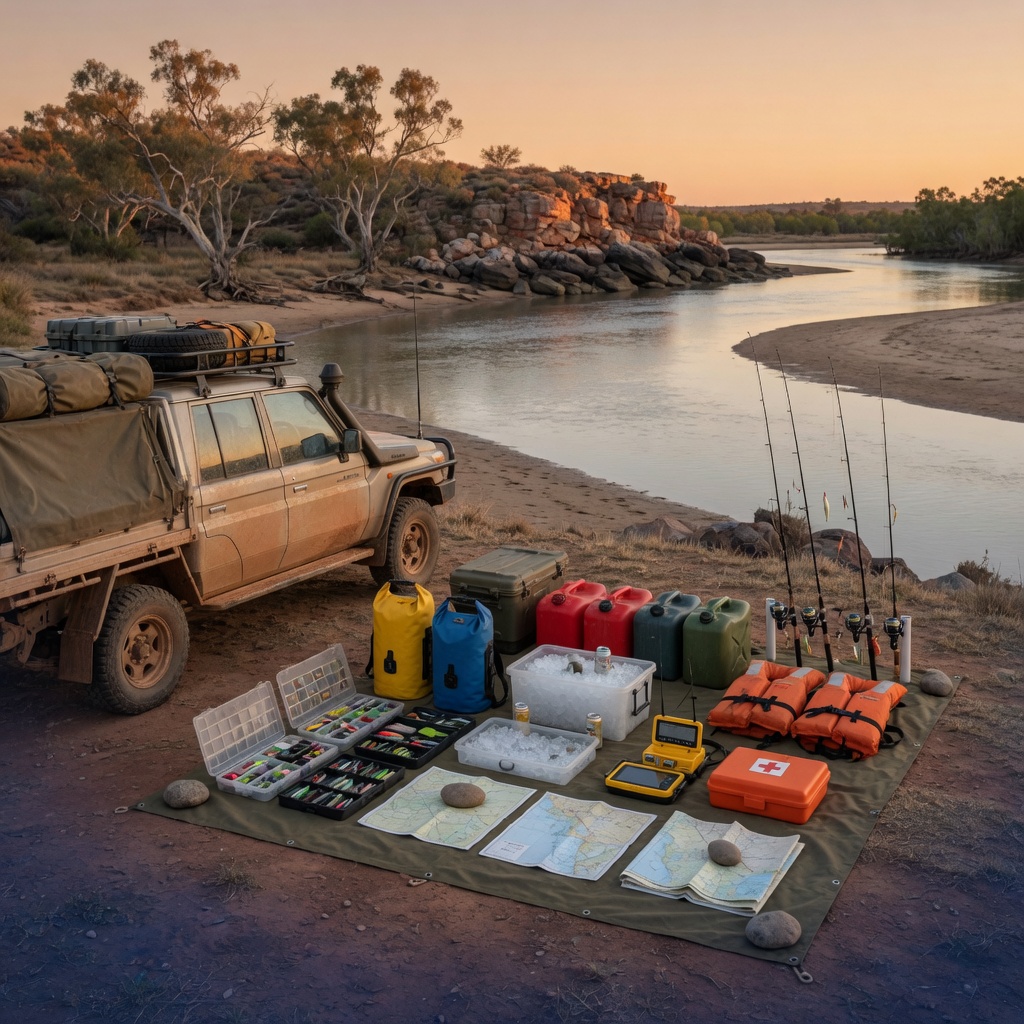
A weekend session out of Sydney can be improvised. A five-day run to a remote headland, a Top End river system or a stretch of the Murray-Darling cannot. Once you are beyond phone coverage, every gap in your preparation becomes your problem to solve alone. The planning method below is used by Australian Fish Species to break a trip into four layers: travel and access, water and weather, safety and communications, then fishing and catch care. Write each layer down. A checklist on paper survives a flat battery.
Layer One: Access, Permits and Timing
Confirm how you physically get in and out before you commit. Check whether tracks are seasonal, whether creek crossings are involved, and whether the last fuel stop is 80 km or 400 km from camp. Many productive areas sit inside national parks, Indigenous land or marine parks, so permits and access approvals may be required and closures can apply at short notice.
- Two independent route options, including a wet-weather exit.
- Tide times for every bar crossing, launch and flats session.
- Moon phase and sunrise/sunset for planning feeding windows.
- Nearest medical facility, ranger station and boat ramp with a phone number written down.
Fisheries rules differ by state and territory and change over time. Bag limits, size limits and seasonal closures for species such as barramundi, Murray cod and snapper are not uniform, so verify current limits with the relevant state or territory fisheries authority in the week before you leave, not from memory.
Layer Two: Weather and Water Conditions
Treat forecasts as a decision tool, not a prediction. For coastal and offshore legs, read the coastal waters forecast plus swell period, not just swell height: a 1.5 m swell at 14 seconds behaves very differently on a bar to 1.5 m at 7 seconds. For freshwater, watch upstream rainfall and river height, because a rising, dirty river can shut down a Murray cod or golden perch bite and make a camp site unsafe overnight.
- Check forecasts twice daily from four days out and note the trend.
- Set a hard "no go" threshold for wind, swell and river height before you leave home.
- Build one spare day into the itinerary so weather never forces a bad crossing.
- Identify a sheltered plan B fishery for each day of the trip.
Layer Three: Safety, Communications and Redundancy
Remote fishing safety is about redundancy rather than expensive gear. Everything critical should exist twice, and someone on shore should know your plan.
- Registered distress beacon carried on the person, not stowed in a hatch.
- Satellite messenger or HF/VHF radio, plus a charged phone in a dry bag.
- Lifejackets worn during bar crossings, rock fishing and night runs.
- Two navigation sources: chartplotter or GPS, plus paper charts or offline maps.
- First aid kit with wound care, tweezers or side cutters for hooks, and any personal medication in duplicate.
- Written trip intentions left with a reliable contact: route, vehicles, vessel details, expected return time and the action to take if you are late.
Layer Four: Fuel, Water, Food and Power
Use the one-third rule for boat fuel: a third out, a third back, a third in reserve, then add allowance for towing a bigger swell or trolling all day. Carry at least 4 to 5 litres of drinking water per person per day in hot northern conditions, and treat any water drawn from creeks. Keep power simple with a dual battery or portable pack, and plan ice or fridge capacity around the catch you intend to keep.
Tackle and Catch Care Checklist
Take fewer rods and more spares of what breaks. Two matched estuary or freshwater outfits, one heavier outfit for mulloway, kingfish or mackerel, and a compact spread of proven lures beats a boot full of half-rigged gear.
- Leader in three breaking strains, hooks, swivels, sinkers, jig heads and split rings.
- Pliers, side cutters, knife, sharpener, a landing net and a knotted or rubberised release mat.
- Measuring brag mat and a release tool for deep-caught reef fish showing barotrauma.
- Bleeding and chilling gear so kept fish reach camp in good condition.
Release the fish you are not eating quickly and with wet hands. Remote fisheries recover slowly, and the habitat you camp beside is part of the catch. Pack out every scrap of line, bait packaging and rubbish.
The Final 48 Hours
Service the trailer bearings, check the spare, test the bilge pump and navigation lights, recharge every battery, refresh the beacon registration details and re-read the forecast. Brief the whole group on the plan, the abort triggers and who does what in an emergency. If you want a second opinion on a route or a seasonal window, contact Australian Fish Species on +61295585271 or [email protected] during Mon–Fri: 09:00 – 17:00 (AEST).
Good remote trips are boring in the best way: nothing breaks, nobody gets hurt, and the fishing time is spent fishing. That outcome is planned weeks earlier, at a kitchen table, with a pen.
Navigation
See also
FAQ