Silver Perch, Redfin and Carp in the Murray-Darling Basin
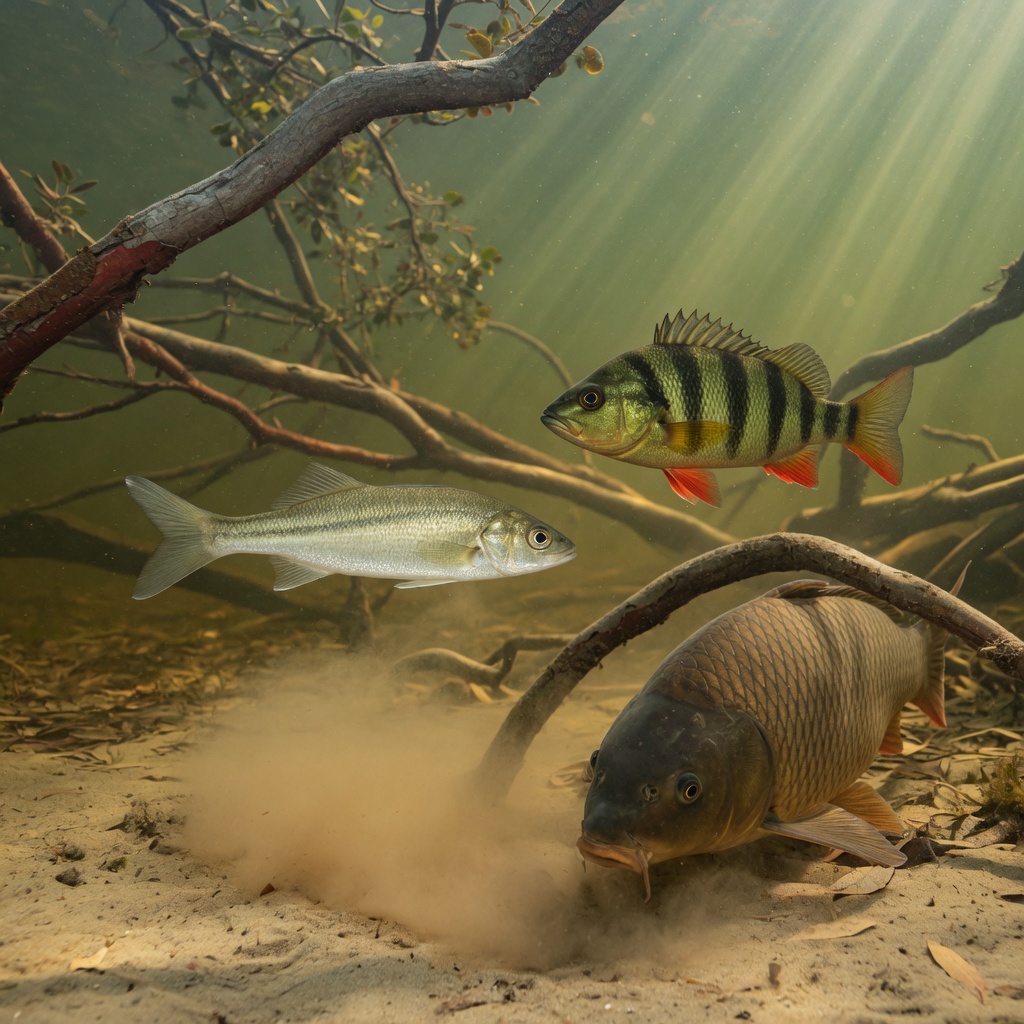
Three very different fish in one river system
Anglers working the inland rivers, weir pools and impoundments of the Murray-Darling Basin will sooner or later meet all three of these fish. One is a native icon in serious decline, one is a widespread introduced predator, and one is the most abundant pest fish in the system. Telling them apart quickly matters, because how you handle a fish afterwards depends entirely on what it is. This guide from Australian Fish Species covers identification, biology, seasonal behaviour and practical handling, and sits alongside our wider fish species profiles and identification resources.
Silver perch (Bidyanus bidyanus)
Silver perch are a slender, deep-bodied native with small scales, a small mouth set low on a pointed snout, and a smooth silvery to dark olive body that fades to a pale belly. The head is small relative to the body and the tail is forked. Unlike golden perch, they lack the blunt, upturned mouth and heavy shoulders; unlike redfin, they have no bold vertical bars.
They are a strongly migratory, schooling fish of flowing water. Historically they moved long distances upstream to spawn on rising flows in late spring and summer, and river regulation, weirs and cold-water releases have hit wild populations hard. In many parts of the Basin wild silver perch are protected or subject to very tight rules, while stocked impoundments may be managed differently. Rules vary by state and change, so always check current size limits, bag limits and closures with the relevant state or territory fisheries authority before you keep anything.
When they do bite, silver perch respond to small offerings: shrimp, worms, yabby tail, small soft plastics and lightly weighted flies fished near current seams, rock bars and the tails of weir pools. Their small mouth means smaller hooks and lighter leaders lift hook-up rates.
Redfin perch (Perca fluviatilis)
Redfin are unmistakable: a deep greenish-bronze body crossed by five to eight dark vertical bars, spiny first dorsal fin, and bright orange to red pelvic, anal and tail fins. They are an introduced European species and are widespread in cooler Basin waters, lakes and slower rivers.
Redfin are voracious, school-forming ambush predators. They hold around weed edges, drowned timber, rock walls and drop-offs, and feed hardest in daylight, particularly through the cooler months and into spring. Small vibes, bladed spinners, 50 to 65 mm soft plastics and live shrimp all work; once you find a school, expect multiple hook-ups from the same structure.
Because redfin are a declared pest in several jurisdictions, moving them live or using them as live bait is generally prohibited. Do not translocate them between waterways, and do not return them to a water where they are not already established. They are good eating, with firm white fillets, which makes harvesting them a sensible option where rules allow.
Common carp (Cyprinus carpio)
Carp are heavy-bodied, deep-bellied fish with large scales, a single long-based dorsal fin with a serrated leading spine, and a pair of fleshy barbels at the corners of a downturned, protrusible mouth. Colour ranges from brassy gold to dark olive-brown. Koi-type and partly scaled varieties occur in some waters.
They dominate many lowland reaches, especially warm, turbid, slow-moving water and floodplain lagoons. Carp muddy the water while feeding on the bottom, which reduces light for aquatic plants and degrades habitat used by native species. They spawn prolifically in spring and summer as water temperatures rise, often in inundated grassy margins.
Carp fight hard and are worth targeting deliberately. Bread, corn, worms and dough baits on a small running-sinker rig or a simple bottom rig will do it, fished in the deeper part of a bend or against a warm mud bank. Carp are a noxious species across the Basin; they must not be returned to the water in most jurisdictions and must not be moved live. Dispose of them away from the waterway, and never leave carcasses on the bank.
Quick identification checklist
- Vertical dark bars and red-orange fins: redfin perch.
- Barbels at the mouth and large scales: carp.
- Small low-set mouth, forked tail, plain silver-olive body: silver perch.
- Blunt, upturned mouth and pronounced hump: more likely golden perch, not silver perch.
Seasons and feeding windows inland
Inland fishing is driven by water temperature, flow and light rather than tide. Redfin fire up in the cold: late autumn through winter and early spring, in the middle of the day when the sun has warmed the shallows. Carp switch on as water temperatures climb from spring into summer and after warm rain lifts river levels. Silver perch activity peaks around rising flows in late spring and summer, though in stocked lakes they can be caught around warmer months near inflows and weed beds. Overcast, stable weather ahead of a front is a reliable window for all three.
Handling, gear and responsible practice
- Use knotless landing nets, wet hands and a wet mat so native fish keep their protective slime coat.
- Carry long-nose pliers and side cutters; crush barbs or cut hooks rather than dig them out of a native fish.
- Keep any silver perch you intend to release in the water while you unhook and photograph it, then support it head-first into current until it swims off.
- Clean, drain and dry waders, nets and boats between waterways to avoid spreading pest fish eggs, snails and weed fragments.
- Never move any live fish, including bait, from one catchment to another.
A 2 to 4 kg spin outfit with 4 to 8 kg braid and a fluorocarbon leader handles all three species comfortably in most Basin waters. Step up to a heavier rod and 10 to 15 kg leader if you are casting into heavy timber where cod are likely bycatch.
Where to learn more
Rules for native and pest species differ between NSW, VIC, SA, QLD and the ACT, and closures shift with spawning seasons and drought management. Treat every regulation summary, including ours, as background reading and verify the current limits with the fisheries authority for the water you are fishing. For questions about identification photos or regional patterns, contact Australian Fish Species on +61295585271 or at [email protected], Mon–Fri: 09:00 – 17:00 (AEST). Our editorial team works out of Sydney and fishes the Basin regularly through the cooler months.

Navigation
See also
FAQ