Soft Plastics for Dusky Flathead on Sand Flats and Drop-Offs
Why Soft Plastics Suit Dusky Flathead
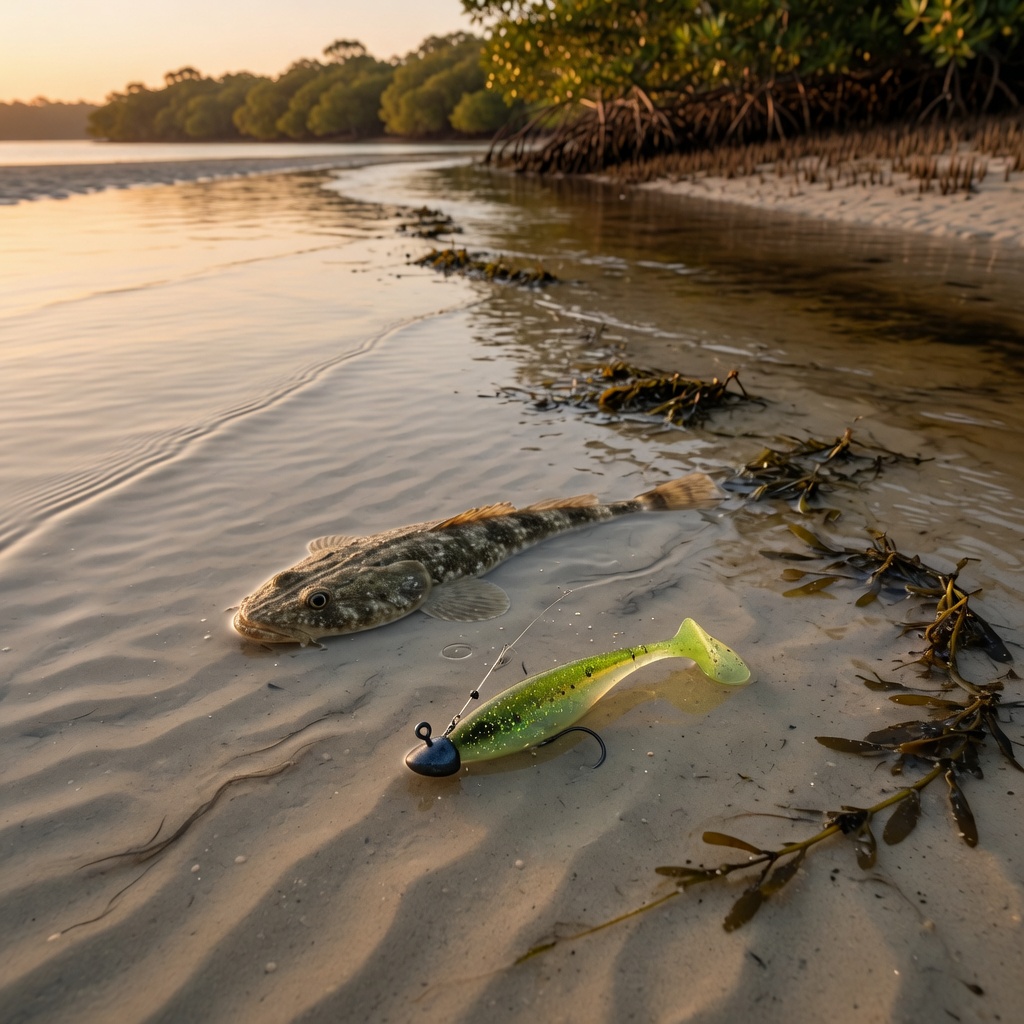
Dusky flathead (Platycephalus fuscus) are ambush predators. They bury into sand or silt with only their eyes and dorsal ridge exposed, then lift off the bottom to intercept prawns, whitebait, mullet and small poddy fish passing overhead. That behaviour is almost tailor-made for soft plastics, because a lure hopped along the bottom mimics a fleeing baitfish or prawn far better than a static bait sitting in one place. Around Sydney, anglers working the Hawkesbury, Georges River, Port Hacking, Botany Bay and Pittwater regularly cover several hundred metres of flat in a session, and mobility is what turns a slow day into a productive one.
Flathead are also a forgiving species to learn on. They rarely spook from a boat or wading angler the way bream do, they hit hard enough to feel clearly through braid, and they hold in predictable structure. For broader identification notes, spine safety and the difference between duskies, sand flathead and tiger flathead, see our fish species profiles and identification section.
Reading Sand Flats and Drop-Offs
Flathead do not spread evenly across an estuary. Concentrate on the transition zones:
- Flat-to-channel drop-offs: the sloping edge where a shallow flat falls into deeper water. Fish sit on the shoulder and just below it, especially on a falling tide as bait is pushed off the flat.
- Weed edges and sand blowouts: pale sand patches inside seagrass beds are classic ambush pockets. Cast beyond the patch and drag the lure through it.
- Drains and gutters: small channels draining a flat funnel prawns and baitfish into a narrow lane on the ebb.
- Sand bars behind oyster leases and mangrove points: current seams here hold fish through the middle of the tide.
- Dark bottom near shell or gravel: darker sediment warms faster in spring and often produces the first active fish of the season.
Look for lies too: a distinct oval depression in the sand, sometimes with a tail print, shows a fish has recently sat there. Where you find one lie, work the area thoroughly, as flathead often stack along a productive contour.
Rigs, Jig Heads and Tackle
A 2 to 4 kg rated graphite rod of 2.0 to 2.2 m, a 2500 size reel, 4 to 8 kg braid and a 3 m leader of 9 to 12 kg fluorocarbon handles most estuary work. Flathead have raspy jaws and abrasive gill plates, so leader heavier than you would use for bream is sensible; step up to 15 to 20 kg if big breeders over 70 cm are likely.
- Jig head weight: 1/12 to 1/8 oz on shallow flats under 1.5 m, 1/6 to 1/4 oz on drop-offs and in current, 3/8 oz when working deeper channel edges from a drifting boat.
- Hook size: 1/0 to 3/0 for 3 to 4 inch plastics, 4/0 to 5/0 for 5 to 7 inch profiles.
- Lure styles: paddle-tails for thump and vibration in coloured water, curl-tails for slow lift-and-drop, prawn and grub profiles for pressured flats, jerkshads for larger fish.
- Colours: natural pearl, motor oil and bloodworm in clear water; chartreuse, pink and dark silhouettes in dirty or tannin-stained water.
Keep the lure sitting straight on the jig head. A plastic threaded crooked spins, tangles the leader and gets refused.
The Retrieve That Works
The core technique is simple: cast, let the lure sink to the bottom on a semi-tight line, then impart two or three short lifts with the rod tip, wind up the slack, and let it fall again. Most bites come on the drop, so watch the line for a tick or a sudden slackening. Vary the cadence until fish respond, and slow everything down in water under about 17 degrees Celsius, when a long pause on the bottom often triggers a reluctant fish.
When you feel weight, sweep the rod sideways rather than striking upwards; flathead often clamp rather than swallow, and a smooth load keeps the hook in the jaw hinge. Expect a second surge near the boat or your feet.
Tides, Season and Weather Windows
The last two hours of the ebb and the first of the flood are the standard windows on flats, as draining water concentrates bait into gutters. Drop-offs fish well across the middle of both tides where current keeps the lure working. Spring through autumn is the peak period, with big females moving into lower estuaries and near river mouths to spawn over the warmer months. Winter fish still feed, but they hold deeper and demand slower presentations.
A light breeze rippling the surface helps on bright days; glassy, high-sun conditions push fish tighter into weed and shade. After heavy rain, work the saltier lower reaches and the clean seam where dirty water meets clear.
Handling, Release and Regulations
Support large flathead horizontally with a wet hand under the belly, avoid the sharp opercular spines behind the gill cover, and use long-nose pliers to remove the jig head. Big females are the main breeding stock, so consider releasing fish over about 70 cm and keeping a small number of mid-size fish for the table. A knotless landing net and minimal air exposure make a real difference to survival.
Bag limits, minimum and maximum size limits and closures vary between states and change over time. Australian Fish Species explains how the rules work, but always verify current limits with the relevant state or territory fisheries authority before you keep a fish. Questions about local flats or seasonal patterns can be sent to [email protected] or raised by phone on +61295585271 during Mon–Fri: 09:00 – 17:00 (AEST).

Navigation
See also
FAQ