Spawning Seasons of Key Australian Species and What They Mean
Why Spawning Timing Matters to Anglers
Spawning is the single biggest driver of fish movement across the Australian calendar. In the weeks before a spawning run, fish feed hard to build condition. During the event itself they may school in predictable places, ignore baits completely, or hold in deeper, more current-swept water. Afterwards they scatter and feed again to recover. If you understand where a species sits in that cycle, you can explain a quiet session that looked perfect on paper, or plan a trip that lands squarely in a feeding window.
Around Sydney and the wider NSW coast, spawning cycles also intersect with regulation. Many states use seasonal closures, spawning-period bans or protected slot limits to shield breeding stock, and these differ from state to state and change over time. Treat every date below as a biological guide, not a legal one, and always confirm current closures, bag limits and size limits with the relevant state or territory fisheries authority before you fish.
Estuary Species: Bream, Flathead and Whiting
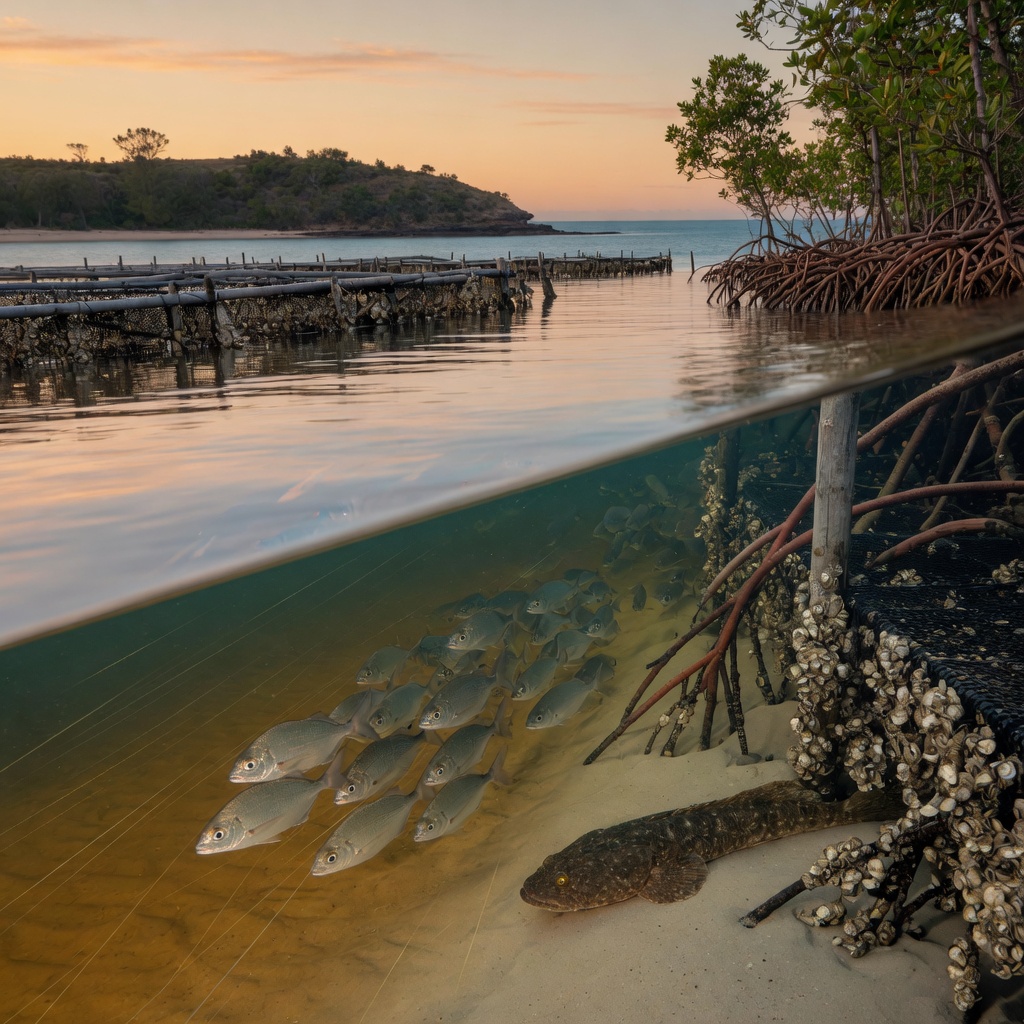
Yellowfin bream in south-eastern Australia typically build into schools through late autumn and winter, moving down estuaries towards the mouths, breakwalls and nearshore reefs to spawn in cooler water. That downstream march is why winter breakwall and headland fishing can be so productive: numbers of fish concentrate in a small area. Once spawning finishes, bream filter back upstream through spring, spreading into flats, mangroves and snag country.
Dusky flathead work the other way in terms of season. They spawn largely through the warmer months, roughly spring into summer, with big females holding in deeper channels and drop-offs adjacent to sand flats. Those large fish are the breeding engine of an estuary, which is why many anglers release anything over about 70 cm regardless of what the rules allow. Sand whiting also spawn in the warmer half of the year, often near estuary entrances and surf gutters, and are notably aggressive feeders on nippers and worms in the lead-up.
How to Fish Around Estuary Spawning
- Fish the staging areas. Deep holes, bridge pylons and rock walls near the mouth hold pre-spawn schools.
- Downsize before, upsize after. Tight-lipped pre-spawn fish often want small baits or subtle soft plastics; post-spawn fish are less fussy.
- Match the tide. Rising tides push fish onto flats; falling tides funnel them into channels where they are easier to intercept.
Snapper and Mulloway
Snapper spawning varies widely by region. In southern waters it generally peaks over the warmer months, with fish aggregating on reefs, gravel patches and inshore grounds. Those aggregations are the reason spring and early summer snapper fishing has such a strong reputation, and also the reason a little restraint pays off long term. Take a feed, release the big breeders and avoid hammering one small mark session after session.
Mulloway spawn primarily through the warmer months in and around estuary mouths and coastal beaches, with larger fish moving between deep holes and surf gutters on the tide. Because mulloway grow slowly and mature late, a 1.2 m fish represents many years of survival. Careful handling, wet hands, a soft net and a quick photo before release are the practical conservation steps most anglers can take.
Tropical and Northern Species
Barramundi in northern Australia spawn in the build-up and wet season, roughly October through to March, in and around river mouths, tidal creeks and coastal flats where salinity suits their larvae. That is exactly why many jurisdictions apply closed seasons over the peak breeding window, and why the run-off fishing that follows is so celebrated: bait floods out of the floodplain and barra feed with real intent.
Mangrove jack spawn offshore in the warmer months after spending their juvenile years in estuaries and snag country, which is why big jacks turn up on reef and headland grounds. Spanish mackerel and coral trout also lean on the warmer months, with coral trout forming spawning aggregations around the new moon on many reefs. Aggregations are easy to find and easy to overfish, so light touch is the right approach.
Freshwater Natives and Trout
Murray cod spawn in spring, generally once water temperatures push past roughly 15 to 20 degrees, with adults laying eggs on hard surfaces such as logs and hollows, and the male guarding the nest. The long-standing closed season across much of the Murray-Darling Basin exists to protect that guarding behaviour. Golden perch spawn in spring and summer and are strongly cued by rising water and flow events, which is why floods often produce a strong year class.
Australian bass are catadromous: mature fish migrate downstream into brackish estuary water to spawn in winter, then return upstream in spring. Winter closures on bass in several states protect that migration. Brown and rainbow trout are opposite again, spawning through autumn and winter and running up tributary streams to gravel beds, which is why many trout waters close over the cooler months and open around the long weekend in spring.
A Simple Seasonal Framework
- Pre-spawn: fish feed heavily and school. Best window for numbers and for personal-best fish.
- Spawn: feeding drops off, fish concentrate. Consider fishing elsewhere and let them get on with it.
- Post-spawn: fish are hungry but scattered. Cover water, fish moving bait and structure edges.
- Off-season: fish settle into stable habitat. Slow presentations and precise structure fishing win.
Layer that framework over tide, moon phase and weather and the picture sharpens quickly. A pre-spawn bream school on a big new-moon tide, or a post-run-off barra on a falling tide over a drain, are the sort of overlaps that turn an average trip into a memorable one.
Fishing Responsibly Through Breeding Periods
Spawning fish are stressed fish. If you are targeting them, use heavier leader to shorten fights, avoid lifting big females by the jaw, support the body horizontally, and release fish promptly at the capture site rather than transporting them. For deeper-water species such as snapper and reef fish, learn to recognise and treat barotrauma with a release weight so vented fish actually make it back down.
Keep learning the fish themselves, too. Accurate identification underpins every rule you follow and every release decision you make, and our species profiles and identification guides break down the features that separate similar-looking species. If you have local spawning observations from your own patch, or a question about a species not covered here, the Australian Fish Species team is reachable on +61295585271 or [email protected] during Mon–Fri: 09:00 – 17:00 (AEST).

Navigation
See also
FAQ