Understanding Current Lines and Fish Holding Areas
Why Current Lines Matter More Than Spots
Most anglers collect spots. Better anglers collect patterns. A current line is simply the visible seam where two bodies of water with different speed, direction, temperature or clarity press against each other. Along that seam, food gets concentrated and predators get an easy feed while burning very little energy. Learn to read those seams around Sydney and you stop guessing where fish sit at any given stage of the tide.
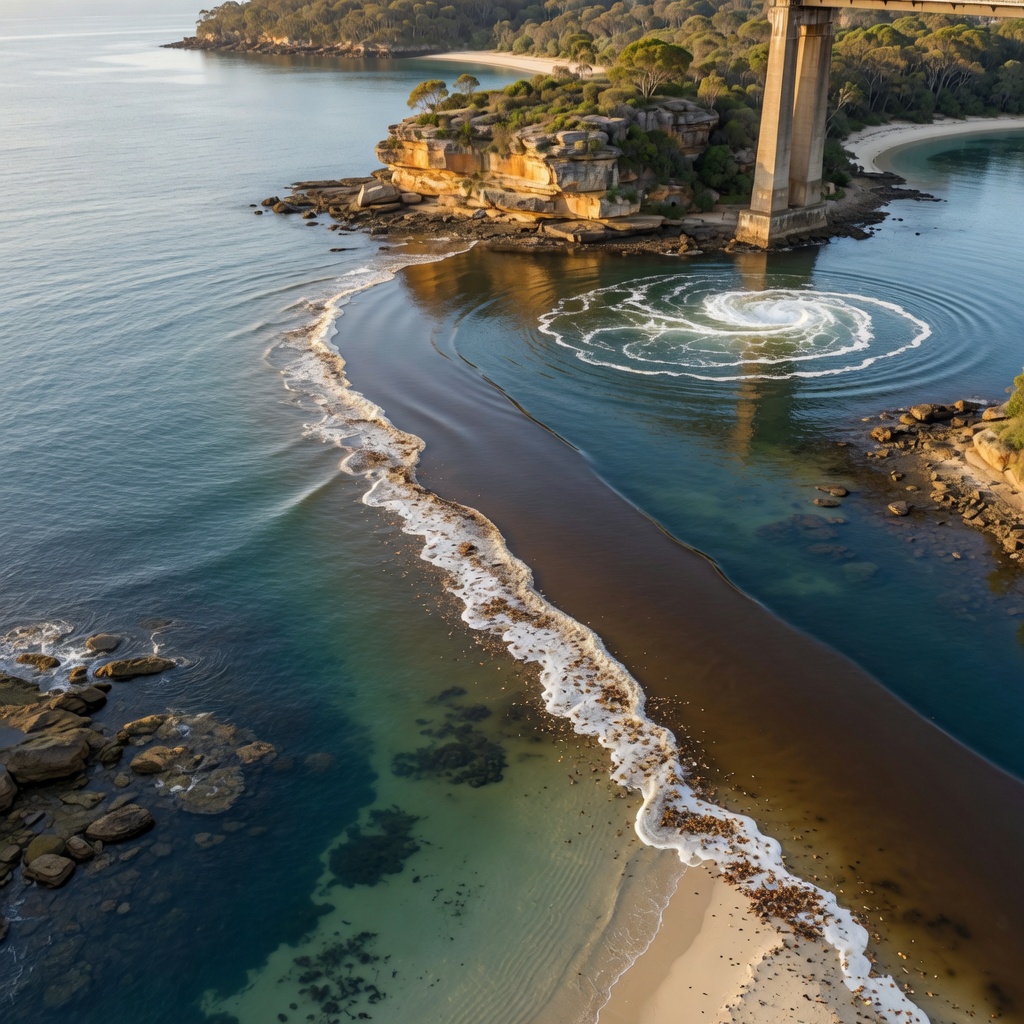
On the water, current lines show up as slicks of calm water beside rippled water, lines of foam and leaf litter, colour changes where dirty river water meets clean ocean water, or a bulge and boil behind a rock or bridge pylon. In Sydney Harbour and the Hawkesbury you can often see them clearly two hours either side of peak flow, when the tidal push is strongest.
The Physics in Plain English
Moving water carries plankton, prawns, nippers, whitebait and yellowtail. When that flow hits an obstruction — a headland, a reef edge, a bommie, a sandbar, a wharf pile, a snag in a freshwater river — it splits, accelerates around the sides and forms a low-pressure pocket behind. That pocket is the holding area. Fish face into the flow inside the pocket, letting the current deliver food to them.
- Upcurrent face: aggressive, feeding fish in the pressure zone, often the biggest specimens.
- Side eddies: where bait tumbles out of the main flow; ideal for flathead and bream ambushes.
- Downcurrent tail: a soft resting zone that holds fish through slack water and after the bite window.
- Seam edge: the exact line between fast and slow water — this is where most strikes happen.
Reading Holding Areas in Estuaries
In an estuary the tide is the engine. On a run-out tide, drains, gutters and creek mouths dump water and food onto flats — flathead lie in the fan-shaped spill just outside, often in 0.6 to 2 metres of water. Bream push tight to oyster racks, rock walls and pontoon shadows on the edge of the flow, then drop back with the falling tide. Mulloway prefer deeper structure: bridge pylons, channel drop-offs from 6 to 14 metres, and the back eddy behind a headland at the start of the run-in.
Practical approach: anchor or spot-lock upcurrent and let baits and lures drift naturally into the seam. Fish do not expect food to swim against the current. A soft plastic that sinks with the flow, or an unweighted bait tumbling down the line, out-fishes a lure dragged upstream nine times out of ten.
Rock, Beach and Offshore Seams
Off the rocks, watch the white water wash back off the platform and form a foam line running parallel to the ledge. Tailor, Australian salmon and drummer work that line hard at dawn and dusk. On beaches, look for the darker channel between banks and the corner where a gutter drains into the shore break — whiting and bream feed on the shallow edge, mulloway sit in the deeper trench.
Offshore, current lines are the whole game. A temperature break of even 0.5 °C, a rip line strung with weed, or the edge of the East Australian Current forming east of Sydney will stack bait and hold kingfish, tuna and marlin. Troll and cast along the clean-water side of the line rather than crossing it repeatedly, and mark the depth where you find bait on the sounder.
Matching Species to Structure
- Bream: tight to hard structure on the seam edge; light leaders, small vibes and hardbodies.
- Flathead: sand and mud eddies beside the flow; slow-hopped plastics on 1/8 to 1/4 oz jigheads.
- Mulloway: deep pressure points and bridge lights at the tide change; live bait or 4 to 5 inch plastics.
- Kingfish: upcurrent face of reef and bommies; live yellowtail, squid or fast-retrieved metals.
- Australian bass and Murray cod: snags and rock bars that break river flow; surface lures at dusk.
If you are still confirming what you have caught, cross-check colour, fin placement and mouth shape against our species profiles and identification guide before you decide whether to keep or release a fish.
Timing the Bite Window
Current strength peaks roughly midway through the tide, so the best windows are usually the two hours of building flow and the first hour of easing flow. Add a new or full moon for stronger tides, and light-change at dawn or dusk, and you have overlapping triggers. In winter, water clarity is often better and seams are easier to see; in summer, afternoon nor-easters can chop out a seam completely, so fish the mornings.
Safety and Responsible Fishing
Strong current lines sit next to hazards. Check the marine forecast before every trip, never turn your back on the ocean when rock fishing, wear a lifejacket on ledges and in small craft, and treat bar crossings with respect. If you release fish taken from deeper reef ground, watch for barotrauma and use a release weight so the fish returns to depth.
Bag limits, size limits and closures differ by state and change over time. Always verify current rules with the relevant state or territory fisheries authority before you fish. For questions about content on Australian Fish Species, contact us on +61295585271 or [email protected] during Mon–Fri: 09:00 – 17:00 (AEST).
Navigation
See also
FAQ