Yellowfin and Southern Bluefin Tuna: Trolling, Cubing and Casting
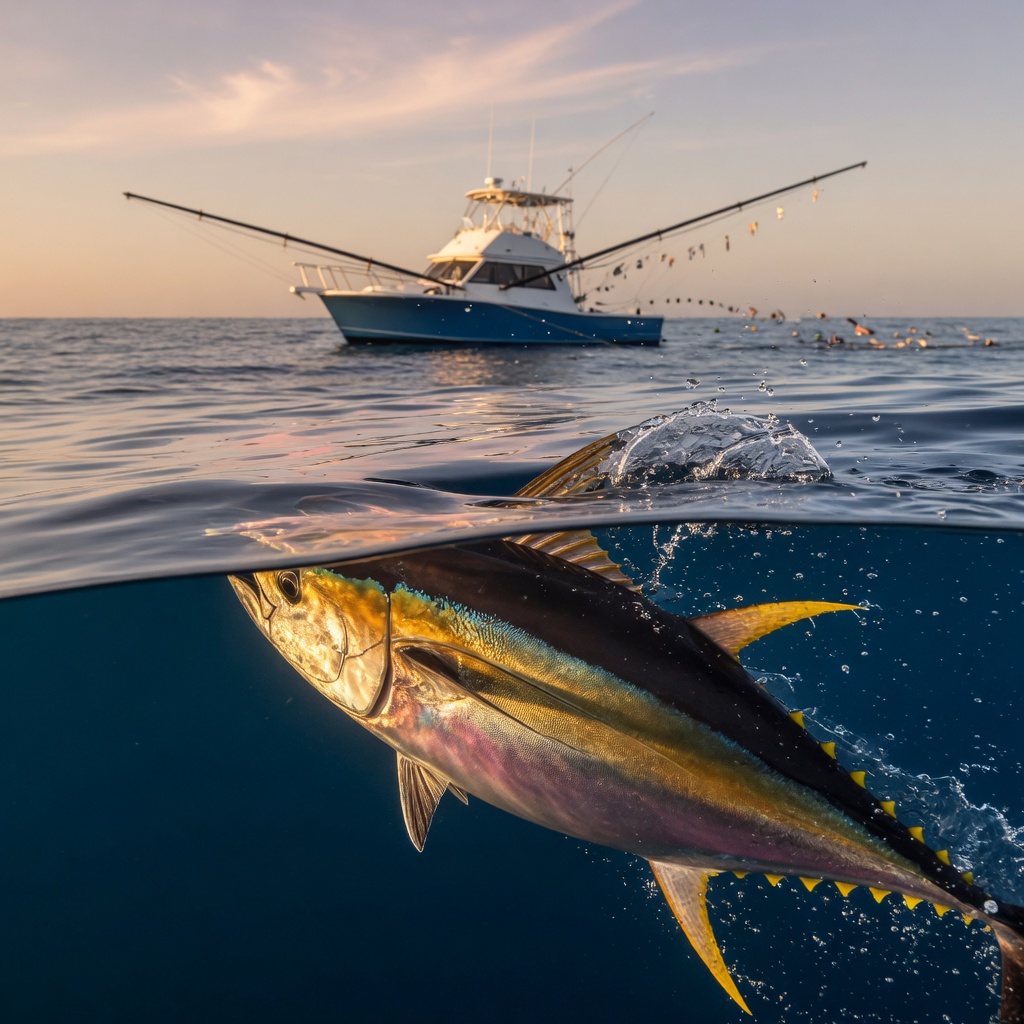
Two Tuna, Two Personalities
Yellowfin tuna (Thunnus albacares) and southern bluefin tuna (Thunnus maccoyii) are the two pelagic prizes that draw offshore crews out of Sydney and ports right along the southern seaboard. They share the same torpedo shape and blistering speed, but they behave differently, feed differently and reward different approaches. Yellowfin are the warmer-water fish, following blue currents and shelf eddies, often holding deeper and feeding with a slower, more deliberate rhythm. Southern bluefin are cool-water raiders that arrive with autumn and winter water, travel in tight fast-moving schools and can strip a spread of lures in seconds.
Identification at the boat is straightforward once you know what to look for. Yellowfin show long, bright yellow second dorsal and anal fins that lengthen with age, yellow finlets with dark edges, and a bronze-gold flank stripe. Southern bluefin are stockier, with short fins, a distinctly yellow keel at the tail, blue-black backs and silvery flanks marked with faint pale spots and bars low on the belly. Getting names and species right matters for both bag limits and record keeping, and our broader fish species profiles and identification notes cover the fine points on similar pelagics such as albacore, longtail and mackerel tuna.
When and Where to Look
Tuna fishing is water-temperature fishing. Off Sydney and the NSW south coast, yellowfin typically appear as the East Australian Current pushes warm blue water in, with autumn through winter the traditional window for larger fish, and smaller school fish showing at other times when conditions line up. Southern bluefin favour cooler water and are most reliable from autumn into spring across southern NSW, Victoria, South Australia, Tasmania and southern WA.
Rather than fishing a mark, fish a feature. The productive ground is usually:
- Temperature breaks and current lines where two water masses meet, often marked by weed, foam and debris.
- The shelf edge and canyon heads where upwelling concentrates bait.
- Working birds, especially shearwaters and terns, and any surface commotion or bait shower.
- Bait balls on the sounder holding between 20 and 80 m, frequently with tuna underneath.
- Whale and dolphin activity, floating objects and long-standing trawler grounds.
Feeding windows tighten around tide change, dawn and dusk, and the days either side of the new and full moon. A moderate breeze that puts a ripple on the surface usually beats a glassy calm for both trolling and casting.
Trolling: Covering Ground and Finding Fish
Trolling is the search method. A simple, well-balanced spread beats a cluttered one every time.
- Set a five-lure spread: two short corners, two long riggers and one shotgun well back in clean water.
- Run skirted lures and bibless minnows between 6 and 8 knots for yellowfin, and small skirts, Christmas trees or deep divers at 5 to 7 knots for bluefin.
- Match hatch size. When bluefin are on small pilchards or redbait, drop to 15 to 20 cm lures rather than big blue-water heads.
- Use a spreader bar or daisy chain to create the illusion of a bait school and pull curious fish into the pattern.
- Set drags at roughly one third of line breaking strain, and step them up only once the fish is hooked and settled.
Mark every strike on the plotter. Tuna work zones, not points, and repeated hookups in the same square kilometre tell you where the bait is sitting.
Cubing: The Patient Method
Cubing is the classic way to work a yellowfin school and it excels on the shelf. Anchor or drift with the current and cut pilchards into thumb-sized cubes, feeding them at a steady rhythm so the trail sinks away at the same rate as the boat drifts. Every ten to fifteen cubes, feed a cube with a hook buried inside it, letting line off freely so the bait falls naturally with no drag or tension.
Key details that decide success:
- Keep the trail unbroken. Gaps let the school drop back or lose interest.
- Use fluorocarbon leader of 24 to 37 kg and the smallest strong circle or live-bait hook the bait will hide.
- Free-spool with the reel in gear only lightly clicked, and never strike hard on a circle hook: wind steadily until weight loads up.
- Have a live slimy mackerel or yellowtail rigged and ready for when a big fish shows in the trail.
Casting to Surface Schools
Casting is the most exciting way to take bluefin and school yellowfin. Approach a surface school up-wind and off to the side, never through the middle, and shut the motor down within casting range. Stickbaits of 120 to 160 mm and metal slugs of 40 to 85 g cover most situations; when fish are picky on tiny bait, a small slug worked at speed usually out-fishes a big lure.
A practical spin outfit is a 6 to 8 kg or 10 to 15 kg class rod around 2.1 m, matched to a 10000 to 14000 size reel loaded with 30 to 50 kg braid and a 30 to 40 kg fluorocarbon leader. Retie your leader after every solid fish and check knots and hook points constantly, because tuna find weak links fast.
Handling, Care and Conservation
Tuna are prime eating fish and deserve immediate care. Bleed and brine or ice fish straight away in a slurry, kept covered and cool. Take only what you will use. Fight fish as hard as your tackle allows so releases are made on healthy fish, use single-hook lures where practical, and support released fish alongside the boat until they swim strongly.
Southern bluefin are a managed and closely regulated species, and rules for tuna differ between states and change over time. Bag limits, possession limits and any tagging or reporting requirements should always be checked with the relevant state or territory fisheries authority before you leave the ramp.
Safety Offshore
Shelf trips out of Sydney mean 40 to 60 km of open ocean. Read the marine forecast for wind, swell period and swell direction, not just wave height, and treat a rising afternoon nor-easter as a reason to turn early. Carry an EPIRB, two forms of communication, flares, life jackets worn on deck when conditions build, and log your trip with someone ashore. If you are crossing a coastal bar, wait for the tide and the lull rather than forcing it.
Australian Fish Species publishes species and destination guides for readers across Australia. Questions or corrections can be sent to [email protected] or by phone on +61295585271 during Mon–Fri: 09:00 – 17:00 (AEST).

Navigation
See also
FAQ